
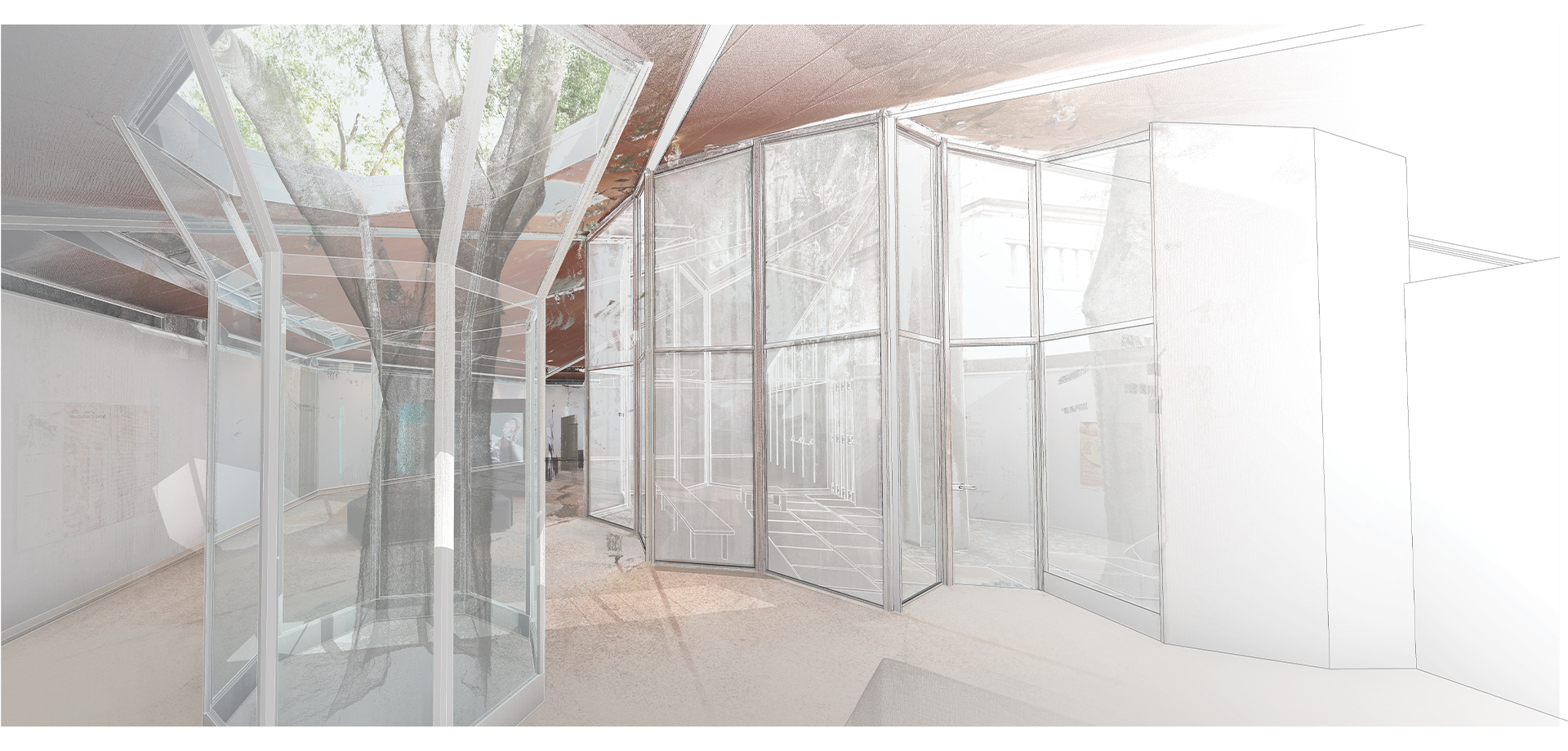
Venice Biennale: Canadian Pavilion
During the summer of 2019, CIMS collaborated with the winning team for Canada’s entry to the 17th Venice Biennale led by Professor David Theodore at McGill University’s Peter Guo-hua School of Architecture. CIMS’ primary role in the project involved creating an accurate BIM for the Canadian Pavilion in Venice based on point cloud data, photographs and drawings provided by the McGill team. In order to assist with their documentation efforts prior to sending team members to Venice, CIMS hosted a master student from the team for a 1 week training session on the principles of laser scanning and photogrammetry during its customary New Paradigm / New Tools initiation week. This is an annual event hosted primarily for members of the New Paradigm / New Tools internship who engage in research abroad. Following this week of training, the McGill team went to acquire the data in Italy. Throughout this process they would send data from on site to our modelling team in Ottawa to verify the accuracy of the scans and commence with modelling.
For the design of their winning competition entry, the McGill team wraps the exterior of the pavilion in green fabric to draw attention to the controversial tipi form of the building as well as to integrate its thematic of film into the exhibit. For the design to work, a highly accurate and detailed model was needed in order to facilitate the tight design intervention on the space. For this, 25mm accuracy was essential to define the space and plan the exact measurements and necessary tolerances of the green fabric. Careful attention to modelling the mullions of the space give greater flexibility to the design team in selecting connection points to the building.
The exhibit, called Imposter Cities, explores how Canadian cities such a Toronto, Montreal or Vancouver often double as other large cities like New York or Los Angeles in film. In response, the exhibit will use a custom green screen intervention to transform a historic part of Venice into recognizable atmospheres of Canadian architecture through the use of an interactive multi-screen video installation that induces alternative ways of experiencing Canadian architecture through film.
To read more on the exhibit, visit the official site of Impostor Cities