
Reconstruct
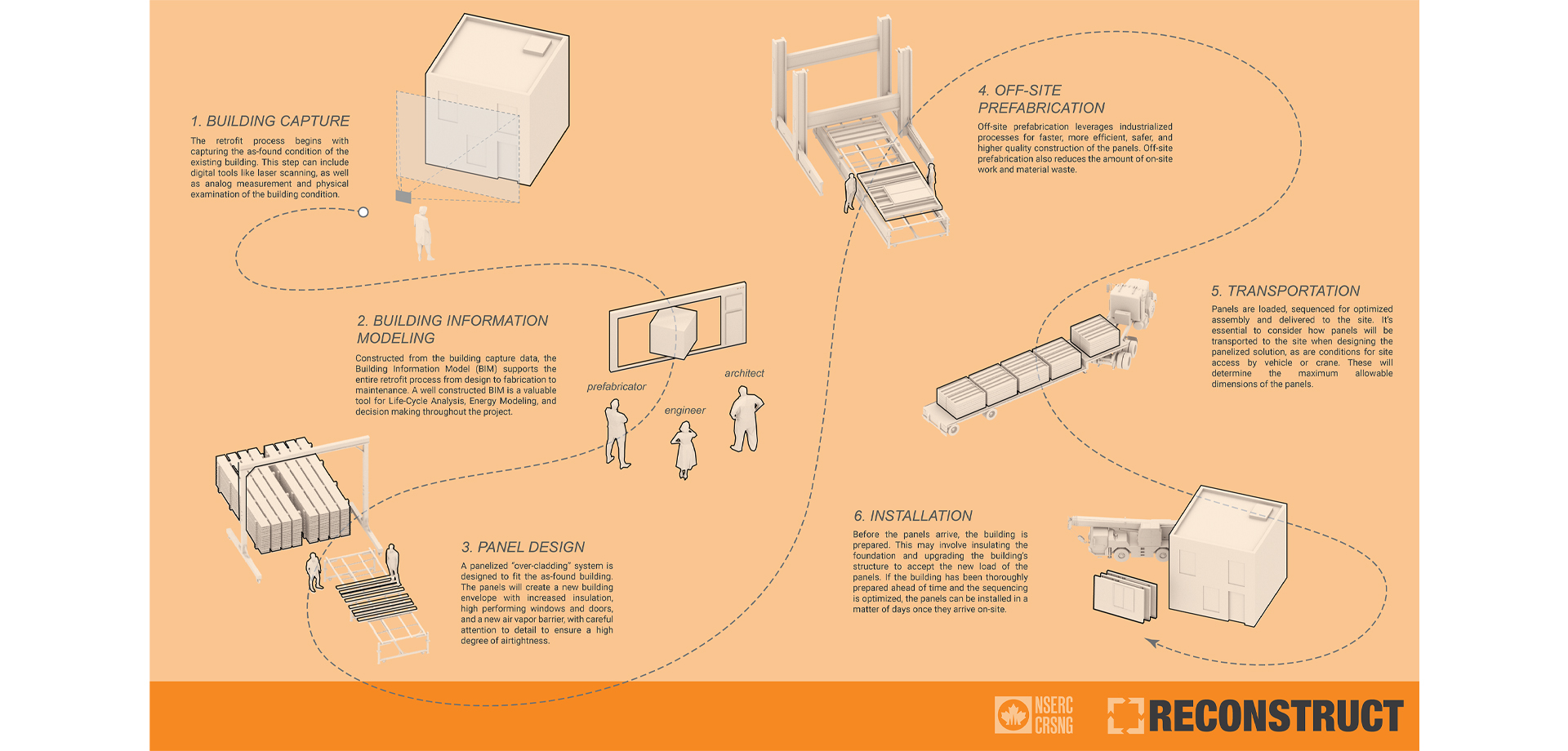
To meet Canada’s climate change targets and reduce greenhouse gas emissions, improving the energy efficiency of existing buildings is essential. To do this, we urgently need strategies that are rapidly deployable, affordable, equitable and reliable. The Reconstruct research initiative, led by Professor Michael Jemtrud, Chair of Architecture, Energy and Environment at McGill’s School of Architecture, aims to develop scalable turnkey solutions for deep energy retrofits (DER) in Quebec and elsewhere in Canada. Our initial focus is on improving the airtightness and insulation of building envelopes using prefabricated panels applied from the exterior of the building. Our approach is centred on applied, systemic and adaptive research, with a focus on multidisciplinarity and collaboration. Reconstruct and the Chair are funded by a Natural Sciences and Engineering Research Council of Canada(NSERC) Alliance Grant (2022-2026) in partnership with Hydro-Québec and the Ministère de l’Environnement, de la Lutte contre les changements climatiques, de la Faune et des Parcs (MELCCFP). Academic principal investigators leading the project include Prof. Mylène Riva (Canada Research Chair in Housing, Community and Health) of McGill’s Department of Geography; Naomi Keena and Nik Luka of McGill’s School of Architecture; the Centre for Advanced Research in Buildings and Envelopes (CABER) led by Prof. Cynthia Cruickshank and the Carleton Immersive Media Studio (CIMS) led by Prof. Stephen Fai at Carleton University. The initiative’s collaborators outside academia include organisations from research, industry, government, and the non-profit and community sectors. This work draws on applied research centered around pilot projects and theoretical research drawing on a variety of disciplines.
The CIMS team is focused on research surrounding methods of building capture and Building Information Model (BIM) creation that streamline the capture-to-manufacturing process. Building capture methods research explores accessible and scalable methods of accurate building capture for a variety of building typologies. BIM research explores how best to leverage building capture data and as-found models to support both other research teams—energy modeling, life cycle analysis, multi-objective decision making—and the design and fabrication of panels. Following installation of the panels a well constructed BIM can then be used to support the monitoring and ongoing maintenance of the retrofitted building.
For more information, specific publications and pilot projects visit the Reconstruct Initiative website: https://aeechair.research.mcgill.ca/en/initiatives/the-reconstruct-initiative
We acknowledge the support of the Natural Sciences and Engineering Research Council of Canada (NSERC). Nous remercions le Conseil de recherches en sciences naturelles et en génie du Canada (CRSNG) de son soutien.