
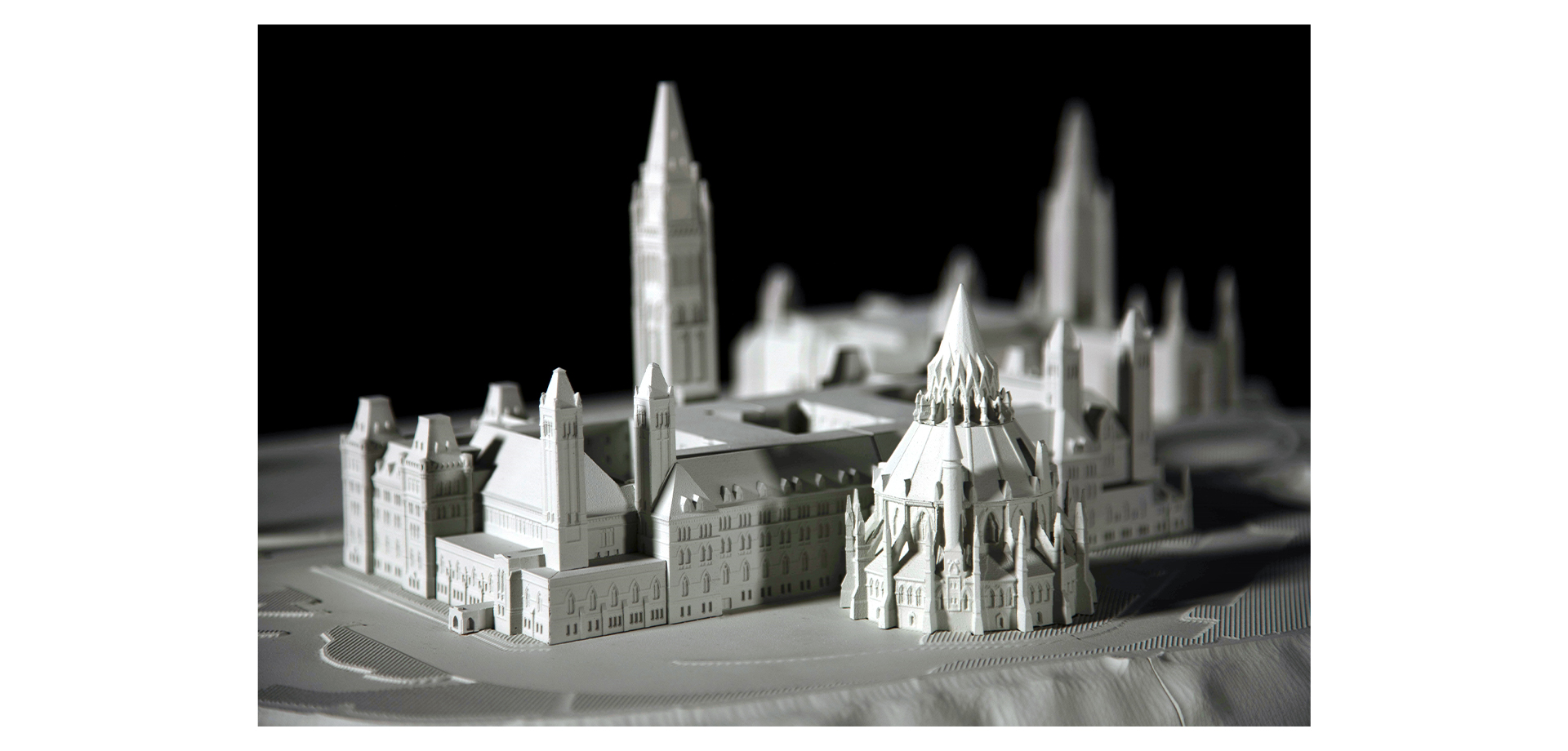
Parliament Hill: Physical Model 2020
In collaboration with the Centre Block Rehabilitation team CENTRUS, CIMS developed a physical model of the Centre Block of Canada’s Parliament. The intent of the physical model is to allow the architects to test and understand design ideas through model making, and to communicate these ideas to project stakeholders, while also capturing the existing condition of the building. Constructed using a combination of CNC milling and hand fabrication techniques, the physical model aims to balance the complexities and intricate beauty of the Center Block of Parliament with a practical scale: 1:500. Measuring a meter square in total, the scale of the model maximizes portability and maneuverability. The physical model includes massing level models of the East and West blocks, as well as the surrounding topography of Parliament Hill.
The 3-axis CNC machine was chosen as the tool of digital fabrication for its rigidity and resulting precision. Although the 3-axis CNC machine is quite rigid, it is also limited in mobility. This means that the parts, not the machine, need to move and rotate to be cut on all the necessary faces. This also means that the model needs to be sectioned into smaller parts that are easily rotatable. The closer a part can be to a simple rectangular prism the better. This intricate division of Center Block into smaller parts results in a more complicated process relying on close collaboration between team members and a strong organization of the fabrication process.
Each piece of the model requires a unique milling program, including detailed finishing passes, rotations, and cut-out operations. Once parts have been milled, they are fully freed from the stock by hand on a table saw. Following this there is further clean-up work by hand using blades, chisels, and hand planes. This work ensures crisp edges, corrects rounded inner corners (an unavoidable side effect of cylindrical cutting tools on the CNC), and ensures a tight fit between different pieces. After clean up the pieces are assembled in a dry fit, making sure that the entire model comes together into a seamless and well made entity. The pieces are then joined with minimal super glue, placed in their respective pockets on the base, and painted using an airbrush.