
Indigenous Virtual Learning Spaces: Tsi tewateriweiastáhkwa
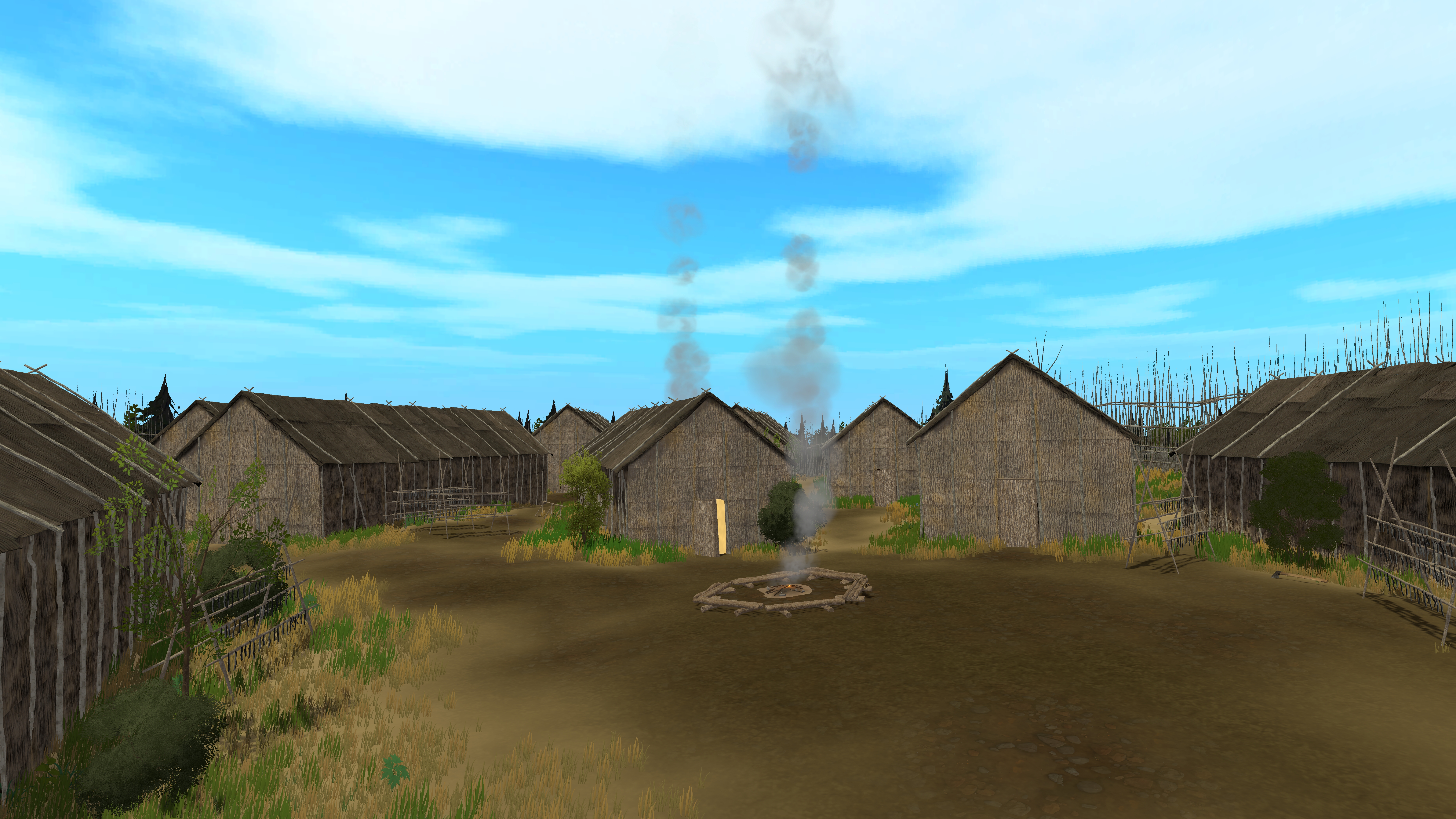
Indigenous Virtual Learning Spaces: Tsi tewateriweiastáhkwa (A Place Where We Learn) is a collaborative VR experience that brings students and educators into a space that can be used for sharing Indigenous knowledge and ways of life. CIMS worked alongside Kahente Horn-Miller—Associate Professor and Associate Vice President Indigenous Teaching, Learning and Research at Carleton—to bring her project vision to life: a virtual space where you can feel connected to the earth around you, with both natural environments and a Longhouse to gather in.
In Tsi tewateriweiastáhkwa, a group of up to twelve students join a guide—professor, guest speaker, or Knowledge-Keeper—via local networking. The group works their way through a forest, cultivated field, village, and into a post-contact longhouse. Their journey is animated by live commentary from the guide and augmented with interactive objects and text available along the way—inviting questions and conversation.
To create an accurate, immersive, and VR-optimized Longhouse, CIMS visited Ganondagan State Historic Site in upstate New York where we documented the interior and exterior of their Seneca Bark Longhouse using laser scanning. The laser scan data was then used as a reference to create the 3D model used in the VR experience. In addition, more than twenty objects found within the Longhouse were documented with photogrammetry.
A Place Where We Learn is available to educators at Carleton University through Teaching and Learning Services at the Experiential Learning Hub.