
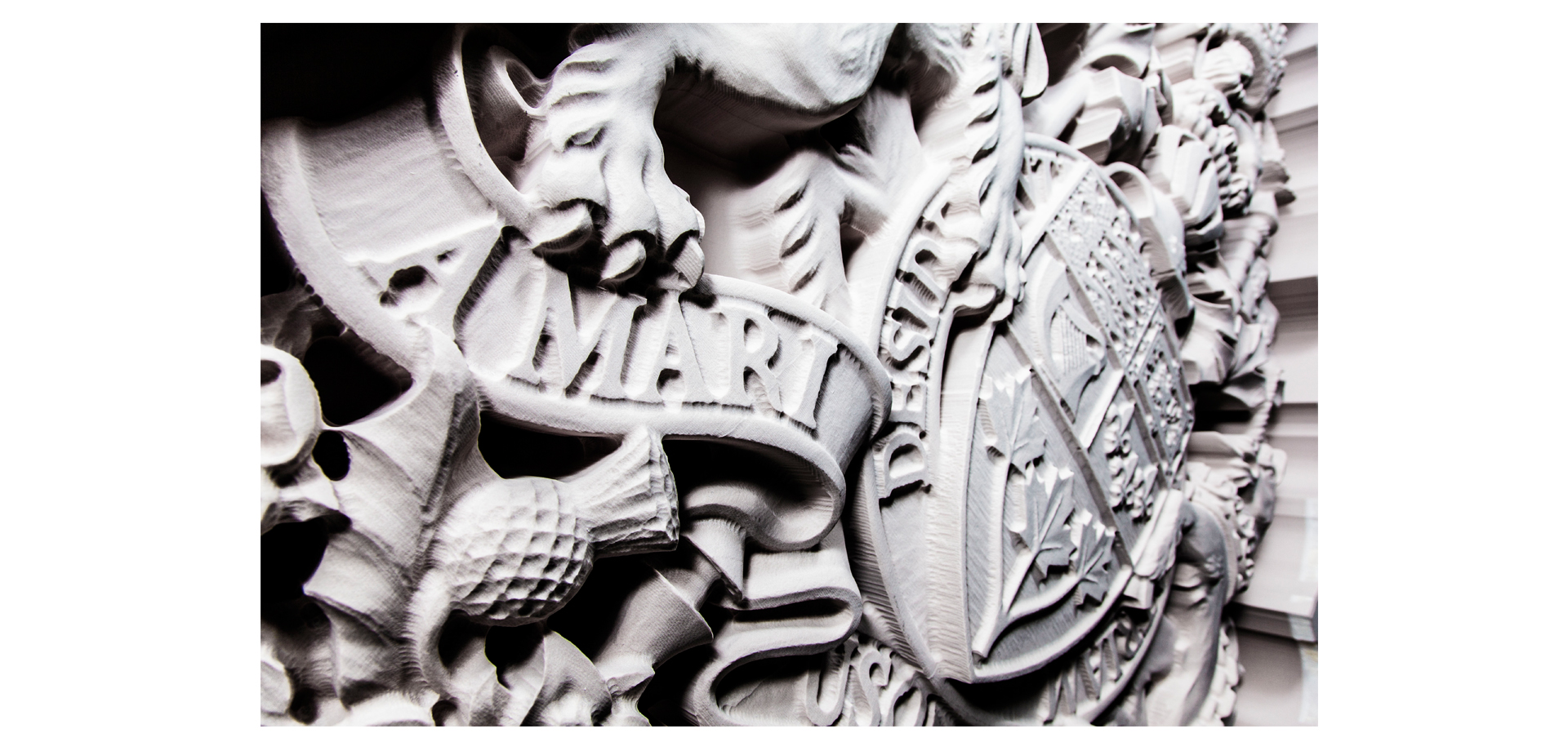
Canada Coat of Arms
The Canada Coat of Arms on the façade of the Wellington Building at 180 Wellington Street was replaced in June of 2019. Carleton Immersive Media Studio (CIMS) assisted Public Services and Procurement Canada (PSPC) in its replacement using the six-axis Kuka Robot.
For the replacement of the stone relief of the Canada Coat of Arms, CIMS partnered with Phil White, the Dominion Sculptor of Canada, in a joint milling and carving project. The original stone relief deteriorated heavily due to weathering and salt damage from the harsh Canadian winters. Instead of the more permeable stone of the façade, the replacement coat of arms is a metal cast.
The process of fabricating the Coat of Arms was iterative. After Phil White carved the mock-up, Heritage Conservation Services (HCS) digitized this original carving into a mesh file, passing along the digitization to CIMS. Upon receiving the mesh file, CIMS scaled the mesh to 1.5 times the original size, making it the largest project ever milled by CIMS. CIMS milled the basic shape, only roughing out the details and then handed the sculpture off to Phil White for hand finishing. This workflow was an ideal partnership between robots and humans because the machines could easily remove much more material in a shorter time than by hand. The inverse is that the robot is not as accurate and detailed as hand carving at finishing, and much slower.
To ensure a high quality finished product, CIMS conducted several tests using the Kuka Robot and lightweight 15lbs foam. The first tests were at a reduced scale and shallow depth to predict possible problems and understand the geometry that was to be milled. Final tests saw the Coat of Arms divided into four portions at full scale to test run the tool-paths and workflow required. These last four tests were taken from different places on the mesh to capture many unique cases of the geometry and thus eliminate as many surprises as possible.
The final product was milled in a single solid sheet of 40lbs foam that weighed over 350lbs before milling. The production of the final sculpture took approximately 20hrs of cutting with the majority of time spent on the roughing where the bulk of the material is removed. The sculpture was only milled for the finish pass with a ¼ inch tool. This allowed enough clarity of detail for the sculptures to accurately finish the final piece, without being too time-consuming. CIMS milled within 5mm of the total depth of the foam. Phil White and his team then finished the surface of the sculpture as well as cut through the foam in the voids. The foam was then used to create the moulds for the casting process.