
Stories from the Bytown Collection: Artefact Photogrammetry
Stories from the Collection is a new digitization project with the Bytown Museum that opens their less-accessible collection in a digital narrative form. This project is made possible through the technology of photogrammetry – measurements from photography. State of the art photogrammetry uses a series of overlapping photos to generate digital 3D models that can be viewed online, 3D printed, or used in movies/video game CGI. 29 assets from the Bytown Museum collection were carefully documented using photogrammetry. Some of the artefacts were from displays in the Commissariat Building, while most were from the collection storage in the Diefenbunker Museum.

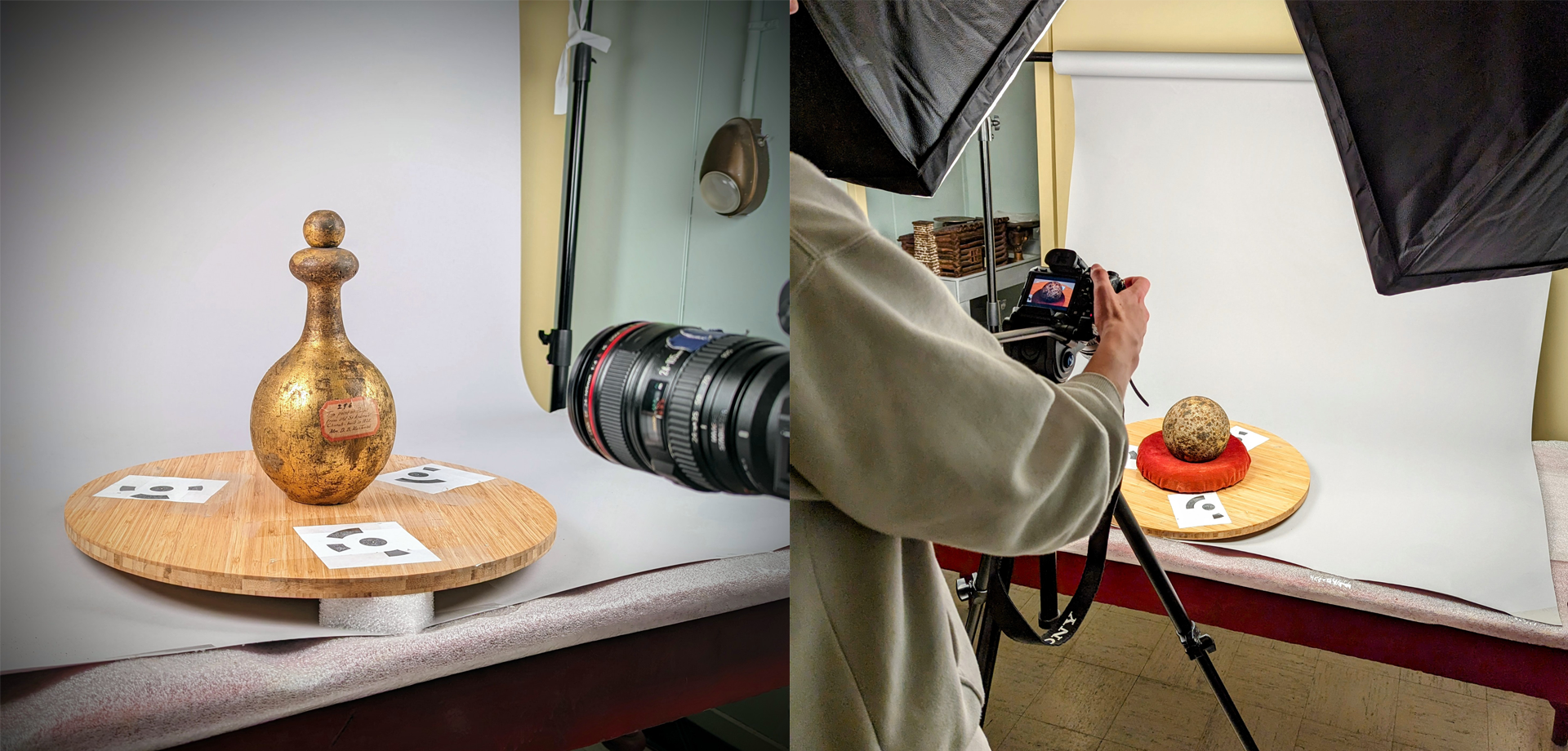
Any camera can be used to capture photogrammetry, but more professional cameras yield higher quality results. A mirrorless Sony a7r iii camera with a zoom lens was used to capture the images, using a tripod for the small objects on the turntable. Remote control strobe flashes with diffuser umbrellas were used to achieve optimal and controlled lighting conditions. For the larger objects, the lights were moved around the object in 8 different setups, perpendicular to all 4 sides and 4 corners. Objects were carefully turned upside-down or on their side to capture all side of the artefacts. A colour calibration card was used in each photo to calibrate the white balance and correct exposure.

When using the turntable, a solid grey backdrop was used to isolate the objects from their surroundings while minimizing the colours reflecting from the surroundings. Depending on the object, the background was switched between black and grey, with the grey paper placed on the turntable to prevent the reflection of the wood on some objects.

While the standard for capturing images in photogrammetry is 60-80% overlap, there were more images captured in this project to ensure all of the surfaces were captured from all angles. The smaller objects took around an hour each to capture, with the largest object taking around eight hours. White archival gloves were worn when handling the objects, as it was imperative to handle the objects with care. The materials of some objects were more compromised than others, and each object was assessed and handled appropriately based on its condition and form.

The acquired raw photos were transferred to the server to begin the processing stage. Adobe Bridge's Camera Raw was used to correct for exposure and colour, which were saved as jpegs. The photos were imported into Agisoft Metashape, with each of the orientations processed separately, aligning the photos and building the mesh from that alignment. Masks were automatically generated around the object from the mesh, and the individual alignments were combined, aligned, and scaled. The textured mesh of the entire object was then created, and exported as a 3D GLB file to be viewed through an internet browser. These 3D digital artefacts are now viewed on the Bytown Museum: Stories from the Collection website, developed by CIMS.
Blog Photography: Grant Vogl