
Voices of CIMS: Josh, Red, Julie
This week, we continue the theme of introducing individual work of the CIMS team through a presentation of insights and short project descriptions they are working on at the lab.
CIMS researcher Josh Wallace reflects on his involvement with the point cloud segmenter application and the process of machine learning:
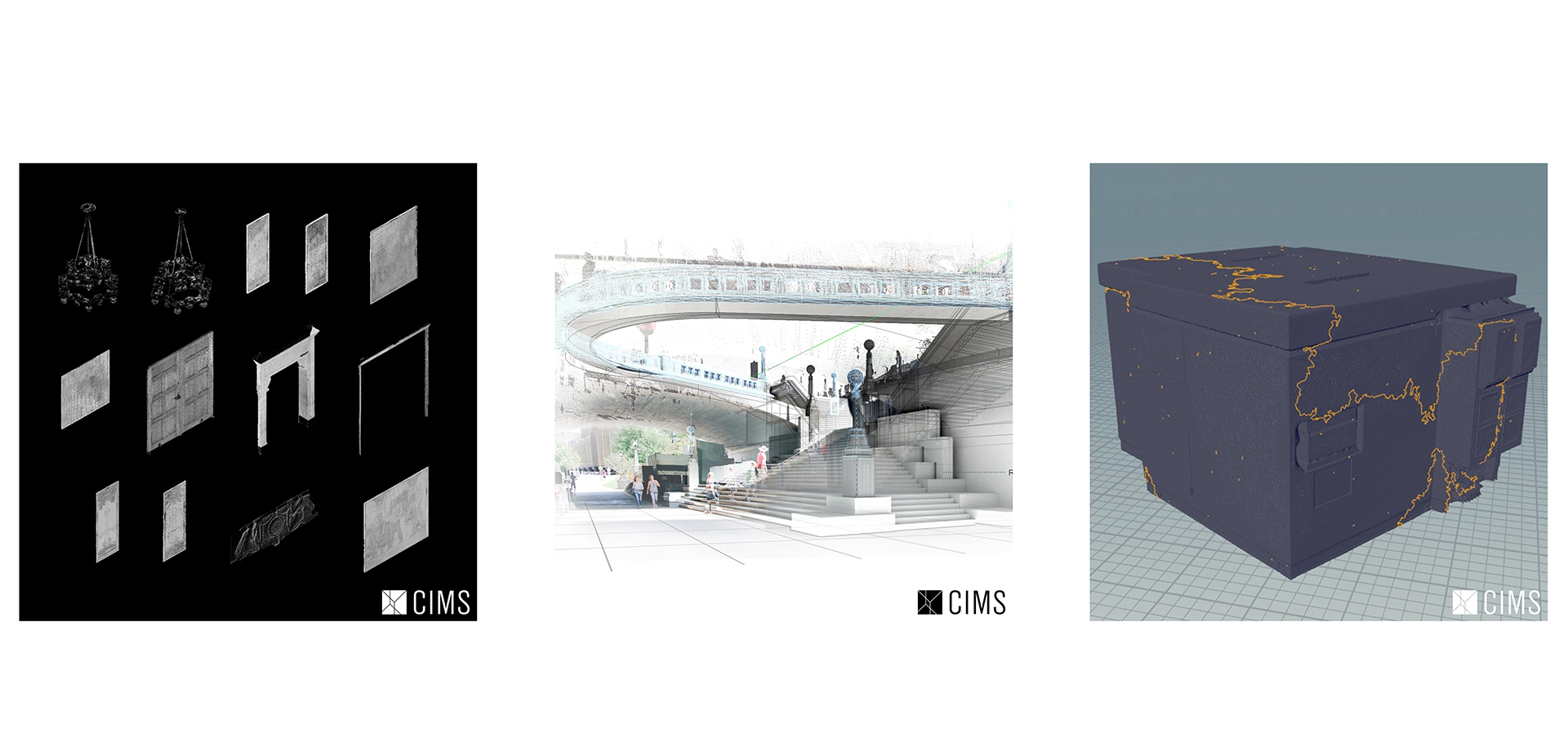
“Manual point cloud segmentation is a necessary step in generating the dataset required to train our machine learning algorithm. Ultimately, the trained algorithm will be able to segment point cloud scans automatically, without human input. In order to get there, however, the algorithm must first be repeatedly shown what a chair is, what a wall is, ceiling, window etc. When segmenting point clouds, the main challenge is to be consistent as to what degree of specificity objects are being segmented, such as if a “door” segment should also include the door’s handle. As it can be expected that that trained algorithm will replicate our logic, coordination between human-segmenters has become especially important. We use a combination of CloudCompare and Autodesk ReCap.” – Josh

Below, Red Narvasa gives a teaser on the National Capital Model of Ottawa – an ongoing collaboration at the CIMS lab. More information on the project will come during the summer! Visit back soon:
“The National Capital Model of Ottawa is a geographic information system (GIS) with diverse layers of metric and non-graphic information, provided by the National Capital Commission (NCC). The GIS database of buildings, vegetation, topography and NCC assets is divided into existing city wards to facilitate organization and model management. Using CAD drawings, point cloud data and Light Detection and Ranging (LidAR), CIMS generated an NCC asset library. This City Information Model (CIM) will allow the NCC to systematically understand and develop their current properties and assets. Furthermore, they will be able to envision future design proposals by using the model as an analytical tool.” – Red Narvasa

Cleaning and preparing meshes for visualization is a common practice at CIMS. Meshes created from laserscanning or photogrammetry often have holes, irregularies, stray pieces or other imperfects. Julie Ivanoff shares her insight into the process of mesh optimization used by the lab:
"On the Mesh Optimization team, photogrammetry scans of rooms are processed to produce files that can be used in game engines. Photogrammetry meshes composed of around 2 million polygons are reduced using Houdini, an adaptable software popular for producing special effects in movies. Instead, we use Houdini to repair holes in the mesh, remove superfluous geometry, and rebuild object, while maintaining as much detail as possible. After optimization, we use xNormal to bake high poly textures to the low poly meshes to transfer a detailed image onto a simplified object. The optimized meshes are then passed on to our Streaming Assets team to be used in game engines for visualization applications." - Julie Ivanoff
