
Understanding the CIMS Streams of Inquiry: Digitally Assisted Fabrication
Starting with the acquisition of two multi-axis fabrication machines in 2016, CIMS began exploring the potential of industrial scale machines to fabricate architectural elements. In contrast to straight technical drawing to fabrication workflows, the Digitally Assisted Fabrication (DAF) research stream is concerned with questioning the methods of producing material objects through the use of computer controlled machines in collaboration with experts in diverse fields. If there is generous sharing of information, collaborations have the potential to develop richer and more nuanced iterations of design while at the same time making the process of design to fabrication more efficient by sharing material and process expertise between parties.
Digital Fabrication: The materials have as diverse a range as the processes and machines that form them -basic process
Digitally Assisted Fabrication (DAF), a term coined by CIMS, encapsulates fabrication workflows that bring together analog and digital methods of making. The aim of the research is to find a harmony between the two different approaches, allowing each mode to benefit and support the other to bring about new/unique/exciting hybrids. There are many definitions of digital fabrication available, but the common idea is that digital data drives manufacturing equipment to form a material object. These methods of making typically fall into two categories: additive or subtractive. The distinctions between these two categories are easily illustrated by the comparison of 3D printing and CNC machining. 3D printing is an additive process which involves the building up of thin layers or extrusions of material into a solid form. Computer Numeric Controlled (CNC) machining is a subtractive process involving the removal of portions of a solid stock material to achieve the desired form. However, digital fabrication is not limited to these two technologies, encapsulating any form of mechanized means of production driven by digital data.
The ongoing work to complete the Sagrada Familia in Barcelona is a unique example of extensive collaboration between masons, architects, and programmers (Burry, 2016). Progressing over time as new sections of the cathedral are built, the collaborations began in 1989 with 2 ½ D robots used to assist the production of the Nave Columns. As new elements of the building presented new and challenging forms, the collaborations between masons, architects, technologists, and robots evolved and innovated. Today they incorporate 7-axis robotic stone milling to not only speed up production time, but also refine and optimize the planned construction of stone elements (ex. The Passion Façade Narthex Columns).
Another compelling collaboration between robotic CNC milling and human hands is the ongoing work of the Digital Stone Project in Garfagnana, Italy. The Digital Stone Project investigates the ways in which contemporary digital technologies can influence modern sculpture through their intersection with ancient Tuscan stone. All aspects of the impact robotic CNC milling can have on the art of sculpture are interrogated, from the impact of these technologies on the design of forms to the interplay of hand and robotic marks on the surface of the finished sculpture.
DAF at CIMS has largely centered on CNC milling, as have the previous examples, working in both 3 and 7-axes across a variety of mediums including foam, wood, and stone. The types of objects produced have ranged from complex scaled architectural models, to full scale sculptures. Regardless of the project or medium, the heart of Digitally Assisted Fabrication at CIMS has always been collaboration. Because of our involvement in important cultural projects and the relationships we’ve built over the years with members of the construction industry, and specifically the talented sculptors at Parliament, CIMS is positioned to continue developing a diverse/unique/ stream of research working with experts of form and materials.
The robot lab at CIMS, located in the Azreili School of Architecture, is home to two KUKA robotic arms set up for 7-axis CNC milling. Each 6-axis robotic arm is equipped with a hi-speed spindle and a rotating work table – the seventh external axis. The KR6 is a smaller robot set up for milling foam and wood and is typically used for making smaller objects or scaled down tests for larger projects. The KR360 is a large (dare we say extra-large) robotic arm set up for milling stone (as well as foam and wood). This necessitates a larger work area, a more robust rotating work table, and water coolant system. Both robots use a wide array of milling tools: roughing and facing tools, flat endmills, ballnose, tapers, and diamond plated for stone milling. For a more detailed tour of the lab see our blog Welcome to the CIMS Robot Lab.
An overarching theme to all our DAF projects is the relationship in any given work between the marks of machines and the marks of human hands, predicated on an underlying foundation that one cannot replace or supplant the other. It is instead in their combination that new realms of possibility exist. Our projects can roughly be categorized into two groups based on the digital data used as the basis of the project. In the first group the data is derived from existing sculptural works, digitized, and turned into meshes from which to generate milling programs. In the second group the data is digital-born, either designed within CIMS or in partnership with external collaborators.
Working with the Dominion Sculptor of Parliament, CIMS has experimented with a number of different approaches to materials and collaboration between master sculptor and CNC milling. The projects range in scale and medium, working in wood, foam, and stone.
One of the first collaborations was the re-carving of an owl relief found on the East Block of Parliament in sandstone. Working back and forth between the digital and the physical the project created a repaired interpretation of the deteriorating original. See the Digitally-Assisted Stone Carving project post for a more in-depth look.
 Fig. 1: Stone Owl Relief, half hand finished over CNC milling.
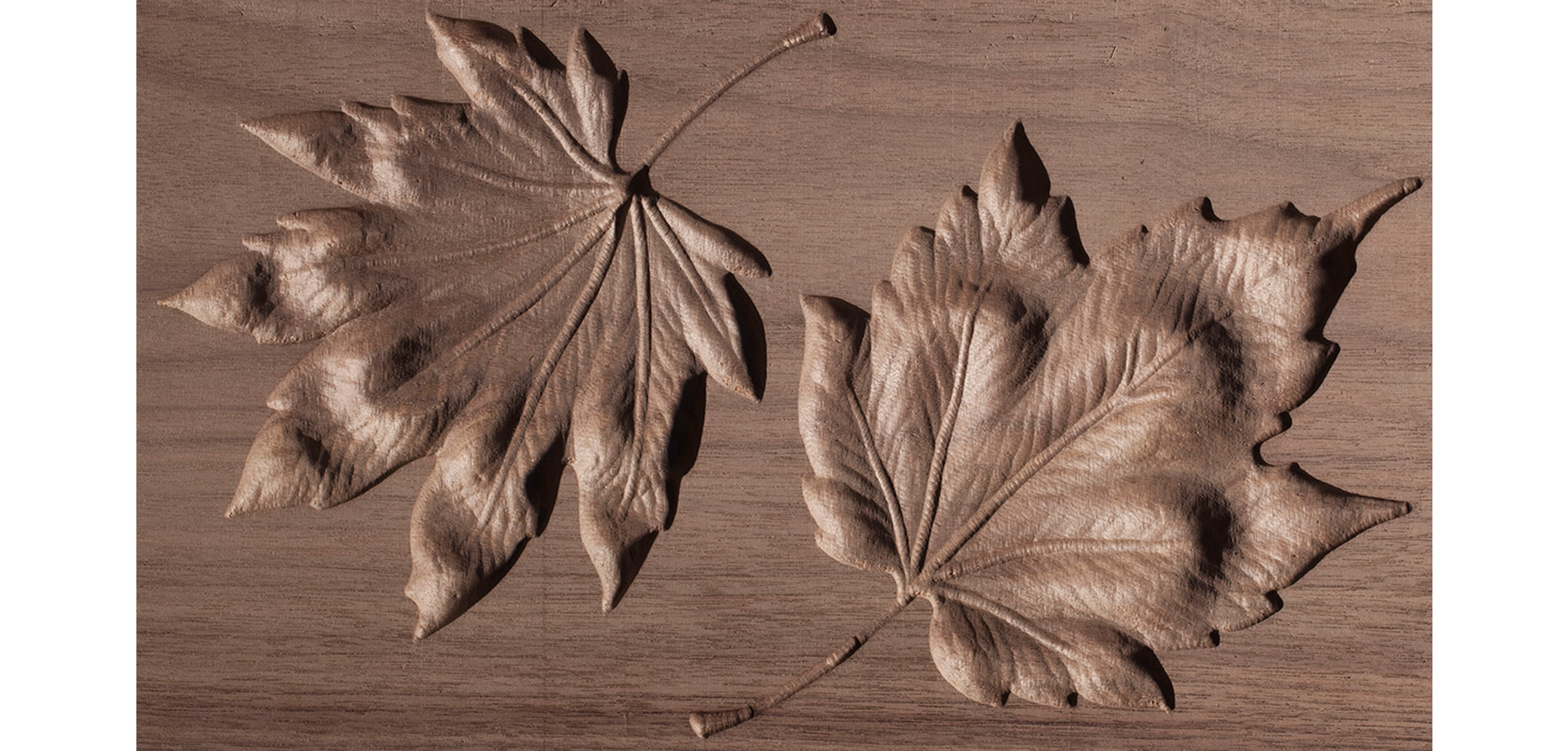
Working in 2017 on the renovation of the Government Conference Center to house the temporary Senate, CIMS, the Dominion Sculptor, and Diamond Schmitt Architects crafted a series of architectural ornaments. A series of twelve leaves were designed and carved in high-density foam by the Dominion Sculptor. After their digitization, CIMS worked with the meshes to replicate the original carvings in walnut for the large ornamental doors to the senate chambers and committee rooms. The same leaves were then milled in high-density foam to become molds for the cast glass windows of the senate antechamber.
 Fig. 2: Final 1:1 test of Leaves milled in walnut by CIMS.
Collaborating once again in 2019 and 2020, CIMS worked with the Dominion Sculptor to reinterpret his carving the Arms of Canada at a variety of scales for different purposes. Each iteration was milled in high-density foam from the digitization of the original carving. The digitized form was easy to manipulate in scale and depth for each iteration.
 Fig. 3: 2020 Arms of Canada in Dominion Sculptor's Workshop during hand-finshing process. Photo courtesy of Phil White, Dominion Sculptor of Canada.
Working with architects and designers CIMS has created the design and fabrication process of several sculptural elements for new construction and renovation projects in a variety of materials. In 2017 CIMS worked with Diamond Schmitt Architects to design Canadian Flag reliefs in walnut to adorn the walls of the temporary senate chamber. This deceptively shallow relief worked with the interactions of milling tool with tool path to create the flowing, three-dimensional illusion.
 Fig. 4: Detail of Canada Flag Relief. Milled in Walnut.
Working with PCL Contractors and B+H Architects, CIMS was asked to collaborate on the modelling of pre-cast concrete formwork. The concrete surfaces appear to be made of stone and earth representing a section cut through earth under the building. Based on the architect’s interpretation of strata found in the earth at the site, CIMS developed 3D models that could be used for digital milling. The process involved ongoing discussions with the architects, engineers, and fabricators to ensure that each iteration met all the material and structural requirements while capturing and developing the visual elements of the design.
 Fig. 5: Detail of Glacial Till Concrete Panel.
In 2020, in conjunction with HOK Architects, CIMS produced a high-detail scale model of the Parliament Buildings in high-density foam. Working from the BIM models CIMS has developed of the three Parliament buildings – East, Center, and West block – the model aimed to capture the maximum amount of detail at a relatively small scale: 1:500. The model was milled on a 3-axis CNC machine in many separate – and sometimes miniscule – parts, and assembled by hand. For a more in depth look at this project keep a look out for the upcoming blog.
 Fig. 6: Physical Model of Parliament viewed from the North-east.
As our research evolves, we are constantly questioning our approach and examining the quality of the output. Each project brings new and unique perspectives to a rapidly changing field of study.
References:
Burry, Mark. “Robots at the Sagrada Família Basilica: A Brief History of Robotised Stone-Cutting.” Robotic Fabrication in Architecture, Art and Design 2016, 2016, pp. 2–15, 10.1007/978-3-319-26378-6_1. Accessed 28 June 2021.