
Torres de Serranos
Developed in partnership with the Universitat Politècnica de València, this project involved the modelling and development of a virtual experience for the Torres de Serranos in Valencia, Spain. Taking the site’s history as the subject, the project explored the potential of heritage asset modelling and gaming technology to visualize the monument’s troubled legacy.
Built in the late 14th century by architect Pere Balaguer, the Torres de Serranos were a key element of the city’s fortifications, serving as a toll gate, as well as a celebrated portal for the next two centuries. In 1586, a fire ravaged the city’s prison, forcing the relocation of prisoners to the Torres de Serranos. Known as the Cárcel de Serranos, the building housed high-profile prisoners in conditions deemed unsanitary. With bad ventilation and overcrowding, the prison was suspected to have caused numerous epidemics in the city. This eventually led to the emergence of calls for the prison to be closed, and for the Torres to be demolished. However, the many conflicts involving the kingdom of Valencia maintained high demand for the housing of political prisoners. Nonetheless, in 1887 it was decided that the Cárcel de Serranos would be closed, and that the site would be restored to its “ancient splendor and beauty.” This idealized representation of the Torres defines how the monument appears today and offers a point of departure for the development of the project.
 Secondary source documents used in the modelling process
The modelling process involved a combination of digital heritage assets gathered during site recording and historical research. On-site data gathering was performed by partners from the Grupo de Investigación en Fotogrametría y Láser Escáner at the Universitat Politècnica de València. As the project’s work was done remotely, numerous challenges were overcome due to the limited access of the site. The documentation is inspired by the notion of Virtual Notebook, which emulates analog surveying notebooks containing a collection of documents from primary and secondary sources. Primary source information, or information derived from the building itself, included a laser scanning survey, as well as photogrammetric assets. These documents are used to create a Building Information Model of the towers as-found. Documents of secondary sources, namely historical drawings and photographs are used to create historical phases based on the as-found model. By making the model a central repository for assets of primary and secondary sources, the documentation produces a form of a digital palimpsest for the comparison of historical phases. The models generated subsequently provided the material to develop a virtual tour that engages with the monument’s past.
 Pointcloud/BIM Overlay
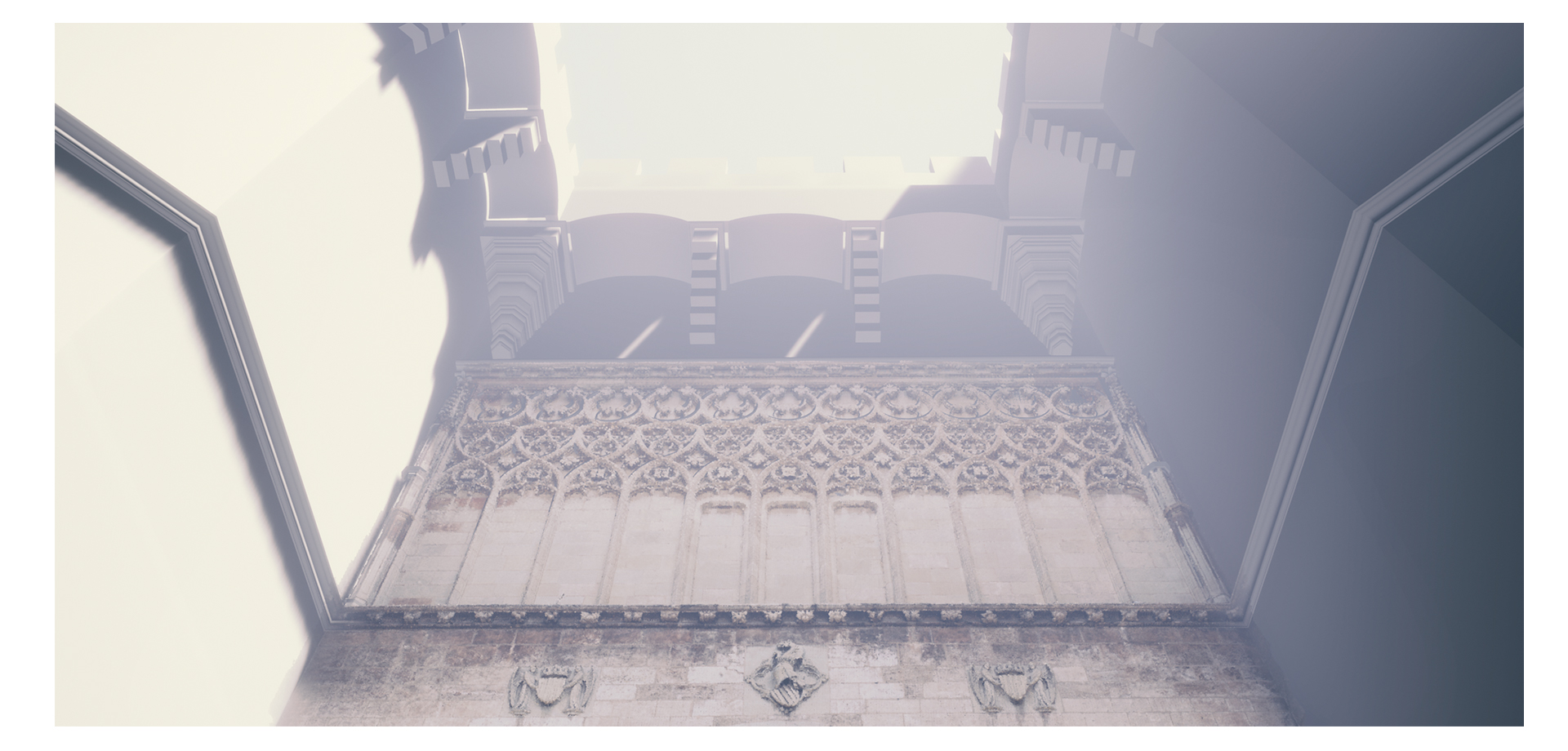
Developed as a prototype, the virtual tour addressed the need to educate visitors on the dark history of the Torres de Serranos. The development of a mini game allowed players not only to experience the space of the prison, but also to contextualize it in time. For this purpose, the prototype involved the conception of interactive controls for the transitions between the site’s phases. By giving control of the experience to viewers, the prototype aims to facilitate learning by reinforcing the feeling of spatial presence, which occurs when viewers become fully immersed in the virtual interface. By having control on certain events in the narrative, visitors can feel more as though they are active participants in the narrative, as opposed to static viewers. This in turn reveals the transformations that contributed to the monument’s perception as part of Valencia’s collective memory. The development of an interactive timeline provides a way for visitors to contextualize the monument in time, thus reinforcing the feeling of participation in historical events. Rather than using controls displayed in the user interface, visitors can navigate between historical periods by crossing the main portal. This aims to reinforce the sentiment of Spatial Presence, and to further immerse visitors in the timeline.
 View of the Cárcel de Serranos in Virtual Tour
As reconciliation with traumatic events becomes part of the larger conversation surrounding heritage preservation, the modelling and digital storytelling of the Torres de Serranos proposes new ways to commemorate. With this project, the research aims to provide a platform for the community to engage in reconciliation with a dark history.