
CIMS Core Faculty: Susan Ross
Susan Ross, a member of CIMS core faculty, is interested in making connections between heritage and waste. If heritage conservation is often defined in terms of what we manage to keep, how does this relate to what and how we discard 'the rest'? Thinking about this in relation to digital technologies has led to question how building materials waste management, BIM for existing buildings, and concerns for the sustainability of heritage inventories could be brought together. As associate professor in the School of Indigenous and Canadian Studies (SICS), and a licensed architect with a cross appointment to the Azrieli School of Architecture and Urbanism, Susan works on multiple research subjects that define and develop our understanding of heritage conservation and sustainability. In addition to publishing in academic and professional journals, Susan keeps her SICS webpage http://www5.carleton.ca/canadianstudies/people/susan-ross up to date and uses platforms like WordPress and Instagram, as flexible instant research podia.
 @wasteheritage https://www.instagram.com/wasteheritage/
Two related areas she is working on that are highlighted on her Waste Heritage Research website https://wasteheritageresearch.wordpress.com include: • "Reading degrees of erasure in demolition photography:" currently at the proposal stage, this study of photographs in the CCA collection will allow her to revisit the relationship between demolition and conservation in the urban contexts she has worked in, including Montreal and Berlin in the 1980s and 1990s. https://wasteheritageresearch.wordpress.com/2019/08/19/degrees-of-erasure/ • "Urban salvage yards as hubs for emerging repair and reuse communities:" based on her visit to the Construction Junction reuse emporium in Pittsburgh during the BuildReuse2019 conference, this work will identify strategies that help connect salvage as a business with a range of social, cultural and environmental objectives. https://wasteheritageresearch.wordpress.com/2019/12/29/construction-junction-pittsburgh/
The blog format lends itself well to photo essays, creating a place to use her own photography as a basis for initial discussion of themes that she is exploring. What starts as a post, documenting field trips, new resources and public lectures, become possible conference papers and components of published work. Recent work on salvage yards will be presented in June 2020 at the Reopening the Bin Waste, Economy, Culture and Society conference at the University of Gothenburg (Sweden).
 CCA photo of Old Montreal in the 1980s: demolition as part of the making of urban heritage
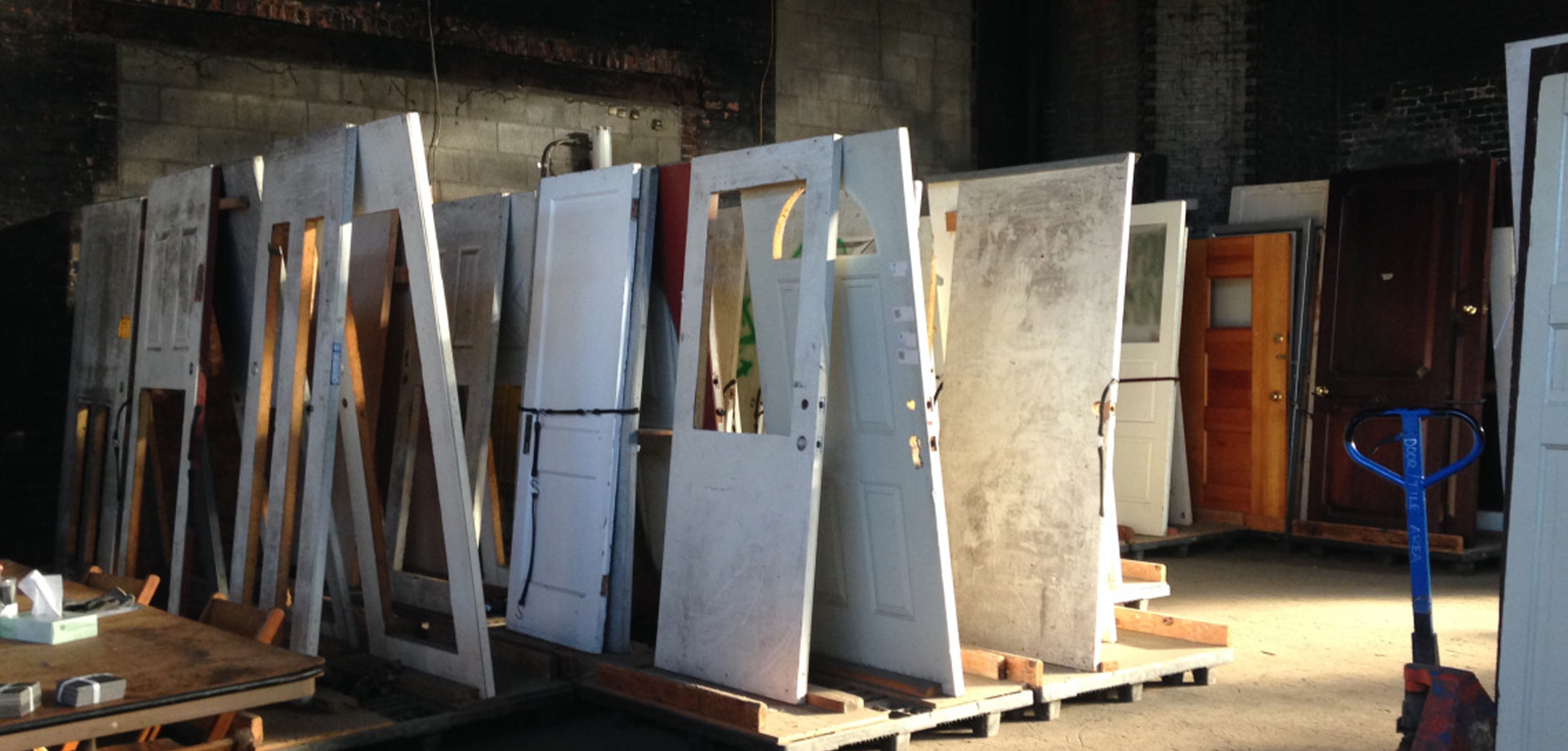
 Construction Junction in Pittsburgh: the salvage yard as an emerging hub for repair and reuse.
Many of Susan's posts explore dimensions of modernist heritage and waste. See: • Discarding modern heritage: the Sir John Carling Building, Ottawa, https://wasteheritageresearch.wordpress.com/2018/02/16/sir-john-carling-building/ • Ottawa Airport’s Wood Reclaimed from Deconstructed Airport Hangars, https://wasteheritageresearch.wordpress.com/2018/03/19/ottawa-international-airport/ • Modern(ist) spolia in the new Ottawa Art Gallery, https://wasteheritageresearch.wordpress.com/2018/04/01/modern-spolia-in-the-new-ottawa-art-gallery/ • Modernist tree waste remodelled, https://wasteheritageresearch.wordpress.com/2019/08/10/modernist-tree-waste-remodelled/
Over the longer term, Susan has been working on defining an ontology of building materials reuse to broaden our understanding of heritage work. This documents projects from Vancouver to Halifax by way of Ottawa that illustrate the range of strategies for reclaiming and reusing materials while following both the policies that enable this work and the stories associated with these materials. A recent publication in The Historic Environment: Policy and Practice discussed the Vancouver context as one that is particularly important in Canada for research and policy on deconstruction.
• Ross, Susan M. 2020. “Re-evaluating Heritage Waste: Sustaining Material Values through Deconstruction and Reuse” The Historic Environment: Policy and Practice. DOI: 10.1080/17567505.2020.1723259
 *UBC Armoury/ CKChoi Building *
The WHR website is also where you can access information about the Heritage in Reverse: Material Values, Waste and Deconstruction Symposium that Susan organized in 2018, including a draft report, videos and photos. This event that brought together founding players, emerging professionals and new scholars in the materials reuse and heritage discussion is now captured in part through a special issue on Heritage and Waste of the Journal of Cultural Heritage Management and Sustainable Development, which Susan co-edited with Victoria Angel, ERA Cultural Heritage Lead and SICS adjunct professor. Four of the symposium's presenters contributed to this special issue. The call for abstracts drew responses from scholars from Europe and other continents, adding perspectives from building science and anthropology, and case studies addressing post-disaster contexts in Italy and Syria, among others. See: https://wasteheritageresearch.wordpress.com/2018/12/02/videos-of-heritage-in-reverse/
 Heritage in Reverse programme and Special issue cover
Susan's research approach is currently less focussed on applying innovative digital technology in documentation or conservation workflows, than on using common digital platforms to explore and document research, while making use of emerging digital resources like the web-based photo and map collections available from the Canadian Centre for Architecture, Library Archives Canada or geoOttawa. Students in her graduate courses in SICS may not have any background in architecture or building technology, and she has found it useful to focus on giving them experience in tools for online publishing while building awareness of how to look critically at archival images from photography to maps in the expanding online resources. See: http://sustainableheritagecasestudies.ca
 New Paradigms New Tools report cover
As a collaborator in the New Paradigms New Tools grant, Susan helped organize an internship for MA graduate student Alison Creba at ERA architects in 2017, which was intended to build on the possible questions emerging around BIM and reuse on heritage sites. Building on a related literature review on the integration of digital data in heritage and waste systems , a review of the work underway in the office led to the preliminary analysis of a series of Toronto projects. These five narratives of materials and values in flow and transformation, illustrate the range of contexts of demolition and reuse in a city now under tremendous development pressure, including everything from small scale and vernacular structures to monumental public and commercial modernist complexes. Alison followed this internship with another at Rotor/rotorDC in Brussels - a design and research group who are actively developing a range of hands on to digital strategies to support deconstruction for reuse. See: https://rotordc.com/about/
At the urban scale, we also need to think about how we are managing data about the existing building stock. Emerging strategies like city-wide surveys could be connected with more informed analysis of the potential for urban environments to serve as anthropogenic quarries. Urban mining is starting to happen anyways, but perspectives from cultural heritage, memories and loss curation will help better inform the changes to come.
This work has potential relationships to two main CIMS areas, modelling and digitally assisted storytelling (DAS). On the one hand, an integrated modelling platform like BIM has huge potential to develop our capacity to address the flows of materials that are temporarily or permanently removed from historic places. Deconstruction is now widely promoted as a strategy for sustainable materials management, but its potential in heritage work challenges the current approaches that mainly focus on those limited elements having perceived persistent value. On the other hand, given the much greater number of buildings that are partially or completely demolished, there is much potential for us to integrate DAS in projects where we are managing loss at some level. In heritage, we mainly focus on certain stories for places with designated values. What would happen if the salvage yard became a drop off place not just for remains but the stories that go with them? On a more pragmatic level, managing materials flows is clearly something that many types of digital systems can help with. The very simple use of tablets in everything from city-wide heritage surveys to salvage retail demonstrates that we now are generating lots of data on what we have. How do we manage this data, sharing it, using it so that we achieve more?
 *Construction Junction staff member demonstrating inputting data for a new acquisition, with same day display online *
A striking example of how easily it could be more was noted when visiting Pittsburgh's Construction Junction, as one of the staff demonstrated the pleasure of being able to quickly enter a newly acquired painted copper cupola into their inventory. Both a story about the element's provenance and an examination of its potential new uses would amplify and help develop the culture of reuse.
Links to above resources:
• http://www5.carleton.ca/canadianstudies/people/susan-ross • https://wasteheritageresearch.wordpress.com • https://www.instagram.com/wasteheritage/ • https://wasteheritageresearch.wordpress.com/2019/08/19/degrees-of-erasure/ • https://wasteheritageresearch.wordpress.com/2019/12/29/construction-junction-pittsburgh/ • https://wasteheritageresearch.wordpress.com/2018/12/02/videos-of-heritage-in-reverse/
Bibliography:
• Ross, Susan M. 2020. “Re-evaluating Heritage Waste: Sustaining Material Values through Deconstruction and Reuse” The Historic Environment: Policy and Practice. DOI: 10.1080/17567505.2020.1723259 • Susan Ross and Victoria Angel. 2020. Heritage and Waste: Introduction. Journal of Cultural Heritage Management and Sustainable Development 10.1. Access here: https://www.emerald.com/insight/content/doi/10.1108/JCHMSD-02-2020-116/full/html • Creba, Alison. (2018) NEW PARADIGMS, NEW TOOLS A Research Report: Developing digital tools utilizing heritage waste. Carleton University. June 2018. • Ross, Susan. (2017). Keyword: Deconstruction Waste (Buildings). Discard Studies. https://discardstudies.com/2017/11/27/keyword-deconstruction-waste-building/ • Ross, Susan. (2017). “Sustainable Conservation Strategies for Canada’s Modernist Wood Legacy.” Journal of Architectural Conservation 23.3, 171-189. http://dx.doi.org/10.1080/13556207.2017.1330385