
The Leaves of the Senate Chamber
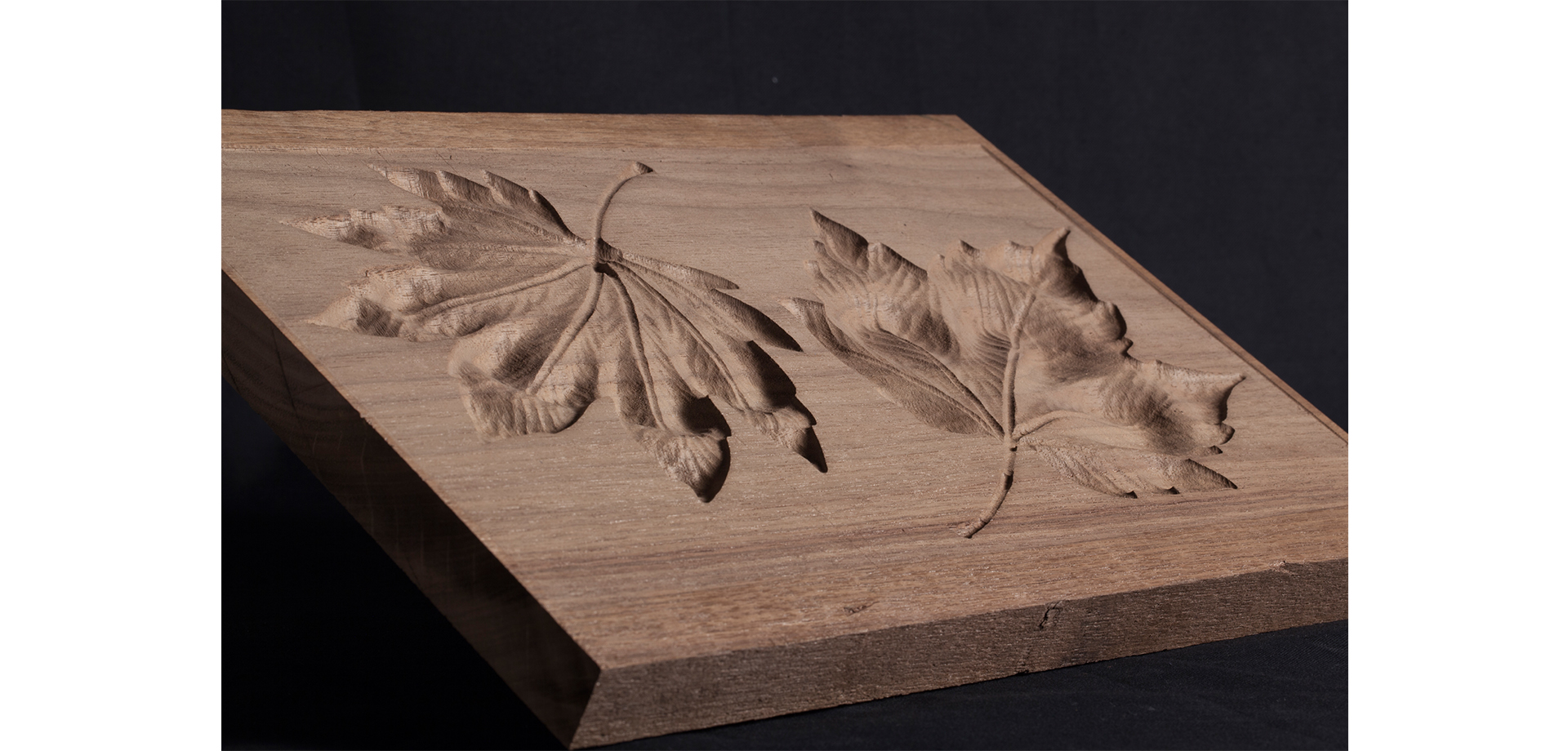
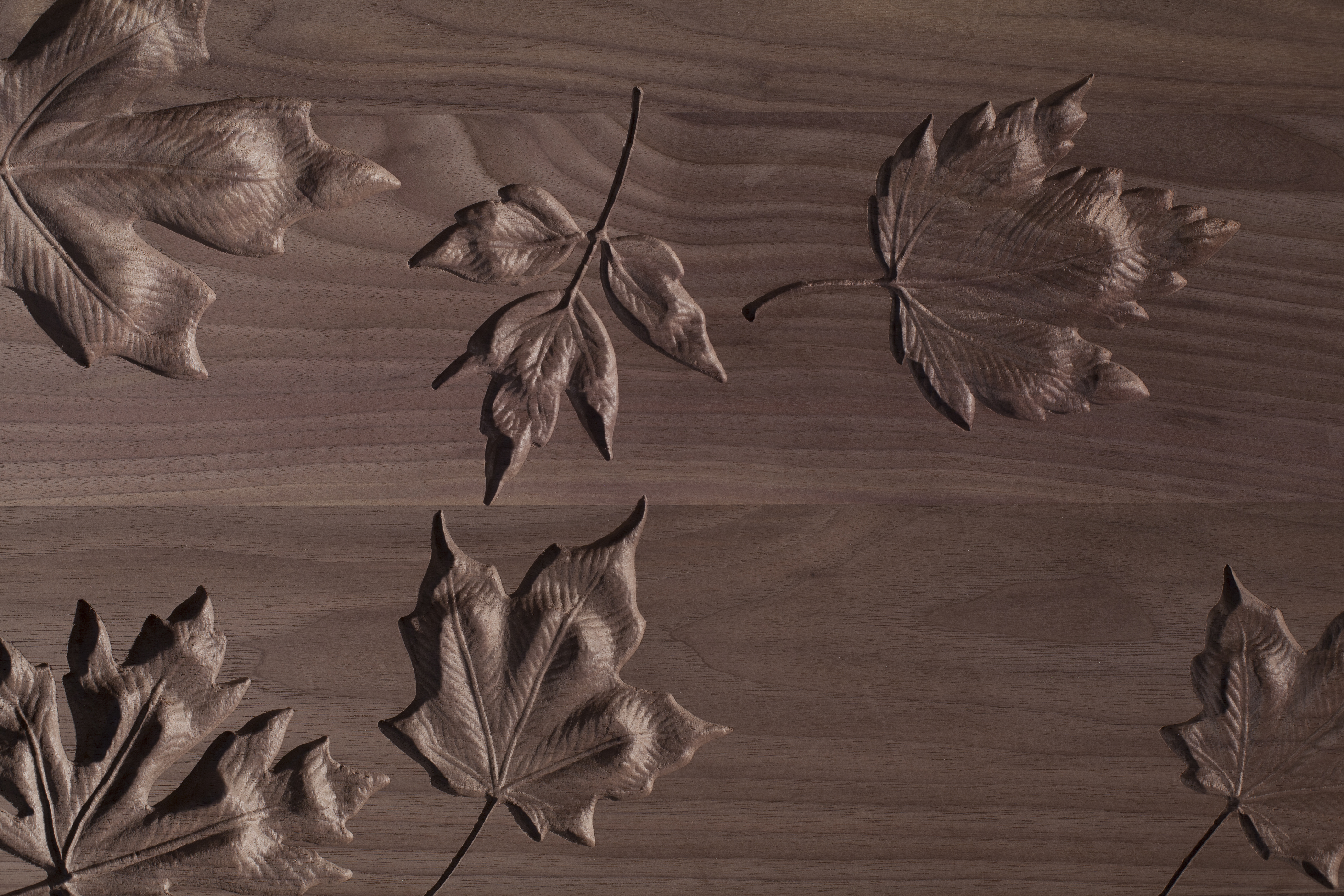
How many species of Maple leaves can you name? After visiting the temporary home of the Senate of Canada in the renovated Government Conference Centre, you may be able to recognize up to twelve. That’s the number of species and variations Phil White, the Dominion Sculptor of Canada, carved by hand to create the ornate details of leaves in the wooden doors, low-relief glass windows, and custom carpeting of the new red chamber. Carleton Immersive Media Studio (CIMS) worked with White to transform his intricate carvings into the repeated patterns in the space. Through digitization and digitally assisted fabrication, White’s original carvings were able to be transformed.
This project is the first of three collaborations with the Dominion Sculptor of Canada, Phil White, for the renovation of the Government Conference Centre to become the temporary home of the Senate of Canada. The refurbishment was overseen by the partnership of Diamond and Schmitt Architects and KWC Architects.
White was originally commissioned to hand carve twelve different species and variations of maple leaves. These include the Big Leaf Maple, the Black Maple, the Douglas Maple, the Red Maple, the Manitoba Maple, the Silver Maple, the Straight Leaf Maple, three variations of the Sugar Maple, and the Vine Maple. Each leaf is cut from a 5” by 5” square of high-density foam, with variations in leaf size depending on the species. After the leaves were carved, Heritage Conservation Services (HCS) digitized the leaves into triangulated meshes using photogrammetry. While data collected from photogrammetry can be noisier than from laser scanning, photogrammetry is better able to capture the fine detail of White’s hand carving.
Upon receiving the meshes, CIMS manipulated and trimmed them to ensure even triangulation, uniform surface normals, and that all holes were patched before milling. CIMS then worked to design tool-paths for CNC milling that would be able to capture and highlight the nuances of White’s hand carving, even when replicated through mass-production. The challenge was achieving the correct balance between the density and detail of the meshes, and the processing and production time. Unlike working with NURBS surfaces or two or three-dimensional curves, triangulated meshes require significantly more processing time to generate tool paths, and many more lines of code per operation. Once a fabrication method had been decided upon, CIMS manufactured a two by two foot walnut sample of a 1:1 portion of one of the Senate Chamber doors. Files for each of the doors were then laid out with the meshes before handing the project off to the final fabricators, Beaubois.
The leaf meshes were used in the fabrication of the Senate Chamber doors, Ante-Chamber doors, committee room doors, and the panes of glass dividing the Senate Chamber and Ante-Chamber. For the glass panels dividing the Senate Chamber and Ante-Chamber, the process differs while the leaves remain the same. CIMS milled the leaves in individual sheets of high-density foam for the creation of the moulds for the glass panels. In total there are six variations of glass panels, differing in leaf layout and size. By milling the leaves individually, the glass manufacturers were able to combine the negatives in infinite combinations to create the necessary moulds. While CIMS milled the individual leaves at their original depths (with a maximum depth of 9mm) the glass manufacturers were able to reduce the depth of the leaves through the casting process to the required 3mm while retaining much of the original detail. Since the glass panels are removed for various Senate events throughout the year, it is essential that they remain light enough to be moveable by hand. After milling the moulds CIMS laid out the leaves in the final files for fabrication before handing the project over to the fabricators.
<video src="//videos.ctfassets.net/ujrjk97g2nk9/7yjum4KWSiR08d1GeEOmfF/5f8e5632b0ff4975e5c82ec66bd2900f/short_milling_leaves.MOV" controls type="video/mov"> </video>For more views of the Senate Chamber visit the photo gallery or head down to the building itself, located at 2 Rideau St. Ottawa, Ontario. To check out our other collaborations with the Dominion Sculptor of Canada for the Senate of Canada visit these blog posts.