
In Celebration of Flag Day!
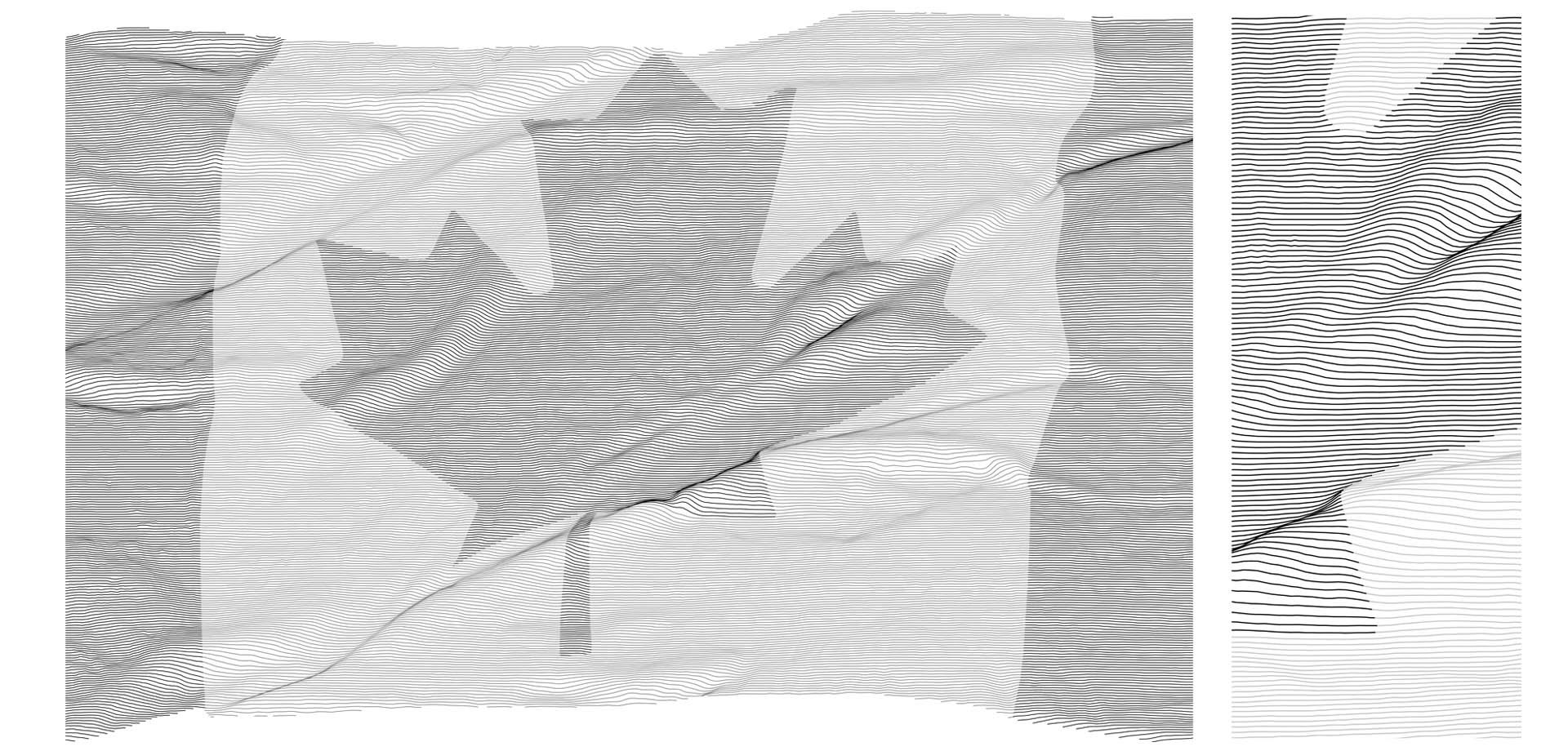
In honour of Flag Day, we wanted to share a recent digitally assisted fabrication project developed through a collaboration between CIMS and Diamond Schmitt Architects and KWC Architects in joint venture (DSA/KWC). As part of their design for the rehabilitation of the Government Conference Centre in Ottawa-now the temporary home of Canada's Senate-DSA/KWC proposed incorporating two images of undulating Canadian flags in the Senate Chamber. The images were conceived as relief carvings cut into walnut panels. CIMS worked closely with DSA/KWC to resolve the technical and aesthetic challenges around transforming the flat images to 3D digital files suitable for computer-controlled milling. The final fabrication was the work of the architectural woodworking masters, Beaubois.

The floor-to-ceiling panels are on the east wall of the chamber, framing the Speaker's Chair and the Monarch's and Consort's Thrones. Each panel measures four metres across and is composed of walnut boards running horizontally. The boards are connected to each other using ship-lap joints. This type of joint allows for the necessary expansion and contraction needed for the wood. However, it makes the allowable cutting depth needed to represent the flags a very shallow 8mm. Both the size of the panels and the method of their assembly posed problems for developing an effective solution.
We began testing with three different approaches to achieve the desired undulating effect: a surface milled with stain to differentiate colours; two surfaces milled with different textures to denote red and white sections; and engraved lines to create the illusion of a rippling surface. During the mock-up process, challenges arose for each of the options. These included wood chipping, limits imposed by the cutting depth, and differentiating between the red and white portions of the flag while creating the illusion of depth.
For all three options, we started with a photograph of a Canadian Flag provided by DSA/KWC architects. From the image, we generated a NURBS surface, which was split into red and white sections. After splitting the NURBS surface into red and white portions, the surfaces were further manipulated for each option. For the options using surfaces with stain or textures to denote changes in colour, the red surfaces were dropped below the white surfaces to create room for a lip to contain the stain or to accommodate textured milling paths. For the option using engraved lines, the NURBS surface was contoured at regular intervals. These contour lines were then rotated slightly and projected onto a flat surface to create 2D lines. The lines were then adjusted in height in relation to one another to differentiate between red and white. The cutting depth was the greatest challenge for this project and resulted in the elimination of the first two workflows, leaving only the option of engraved lines simulating the rippling of the flag.
The engraved lines were cut into the wood using two different angles of V-Groove tools: sixty and ninety degrees. These tools cut a triangular profile into the wood along the 2D contour lines generated from the NURBS surface. By using trigonometry, we were able to determine the different depths at which both angles of V-Groove tools would be at the same width. This ensured that the grooves of the contours remained continuous across the flag while varying in depth to differentiate between red and white portions.

The next problem to address was the wood chipping that occurred while using the V-Groove tools. Where the grooves meet, a knife-like ridge may form and when cut across the grain wood chipping can occur. However, this was solved by rotating the grain direction of the walnut to be parallel to the contour lines resulting in a smooth finish.
Once this workflow was tested numerous times, and all challenges pertaining to manufacturing were understood, CIMS prepared the digital files for production. The final full-scale panels were then manufactured offsite by Beaubois, adhering to the standard of quality achieved in the prototypes created by CIMS.
For more information on our digitally assisted fabrication research, please check out our project and blog pages and the recent Ottawa Citizen article on the Senate relocation.