
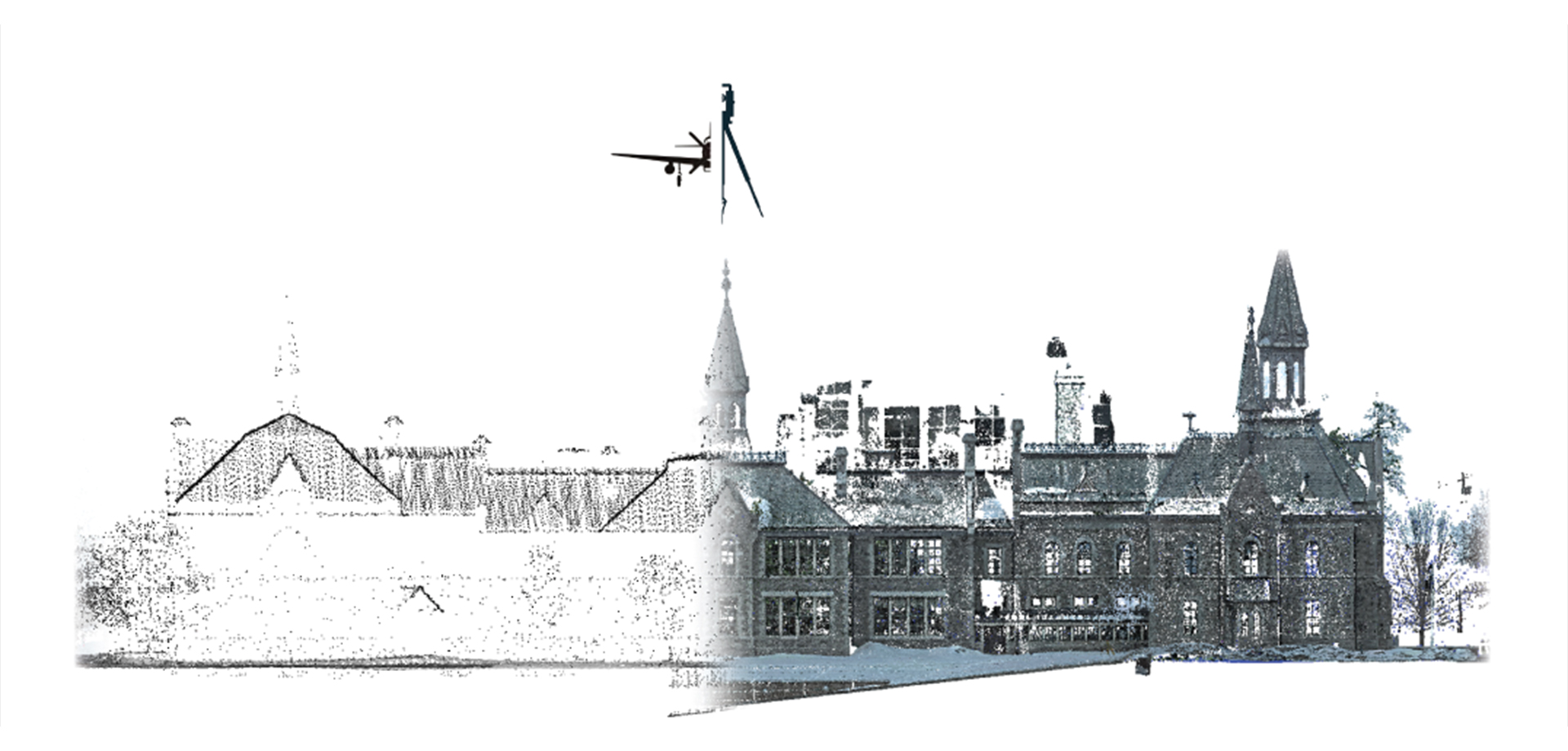
RAICxCIMS Collaboration for Continuing Education
CIMS has teamed up with the Royal Architectural Institute of Canada to provide cutting-edge virtual continuing education courses for heritage conservation. Existing Conditions Modelling Fundamentals is a highly interactive online course that expands on the fundamentals of Heritage Building Information Modelling (HBIM).
Over the last decade, CIMS has become a pioneer in the application of Building Information Modelling for architectural rehabilitation and heritage conservation. Our HBIM projects have ranged in scale from one-room prairie churches to national historic sites (Parliament Hill) and world heritage sites (Rideau Canal). Through these projects we’ve learnt a thing or two about the common challenges you may encounter and the best practices to mitigate them, selecting the appropriate method of digitization, and modelling building elements accurately to point cloud data.
This intimate knowledge of digitization and BIM for the representation and management of existing built assets put us in a unique position to contribute to the education of professionals in the digital heritage sector of the architecture, engineering, construction and operations industry.
 Exploded Axonometric of an existing building from the Windmill Development shown in an animation
More about Existing Conditions Modelling Fundamentals:
Familiarize yourself with the important high-level concepts that will keep you current in practice. Gain the confidence to discuss the concepts of HBIM workflows, data acquisition and output, and key challenges in Heritage BIM with your team and clients. Practice your skills with guided learning and coaching that will build your confidence.
This two-part online course is designed for architects and professionals in the AEC industry. In Part One of this online course, learn on-demand at your own pace. Then, in Part Two, take advantage of live online coaching with the Carleton Immersive Media Studio team! Ask questions, get feedback, and network with other participants.
Part 1: Data Acquisition and HBIM Summary and Learning Outcomes
Data Acquisition and HBIM is an introduction to the concepts of Heritage BIM vs. BIM. Architects who are new to the concepts will find this self-directed online course a great way to become familiar with the high-level concepts. This is an excellent online course for owners, principles, and managers of architecture firms who want to understand the fundamental concepts of HBIM and BIM and be able to speak to clients about its benefits and opportunities.
Learning Outcomes:
At the conclusion of this course, participants will be able to:
- Describe the basic concepts and characteristics that distinguish building information modelling (BIM).
- Explain why, and assess when, BIM is appropriate for existing and heritage buildings.
- Detail the process for managing BIM for existing and heritage buildings.
 *Ashton Church Point Cloud Data
Part 2: Point Cloud to BIM with Revit Summary and Learning Outcomes
Point Cloud to BIM with Revit compliments Part 1: Data Acquisition and HBIM by providing more intermediate knowledge and an opportunity to practice the skills learned. In Part 2, you will learn how to model a heritage building from point cloud data with step-by-step guided video tutorials. This online course connects the participants and the CIMS team through a live virtual meeting where the CIMS team will review participants’ models and provide coaching and guidance.
Learning Outcomes:
At the conclusion of this course, participants will be able to:
- Describe the basic concepts and characteristics that distinguish building information modelling (BIM).
- Explain why and assess when BIM is appropriate for existing and heritage buildings.
- List the appropriate techniques for acquiring and creating digital assets.
- Detail the process for managing BIM for existing and heritage buildings.
- Develop the basic skills necessary for developing a building information model of an existing building from point cloud data in Revit.
For more information click here.