
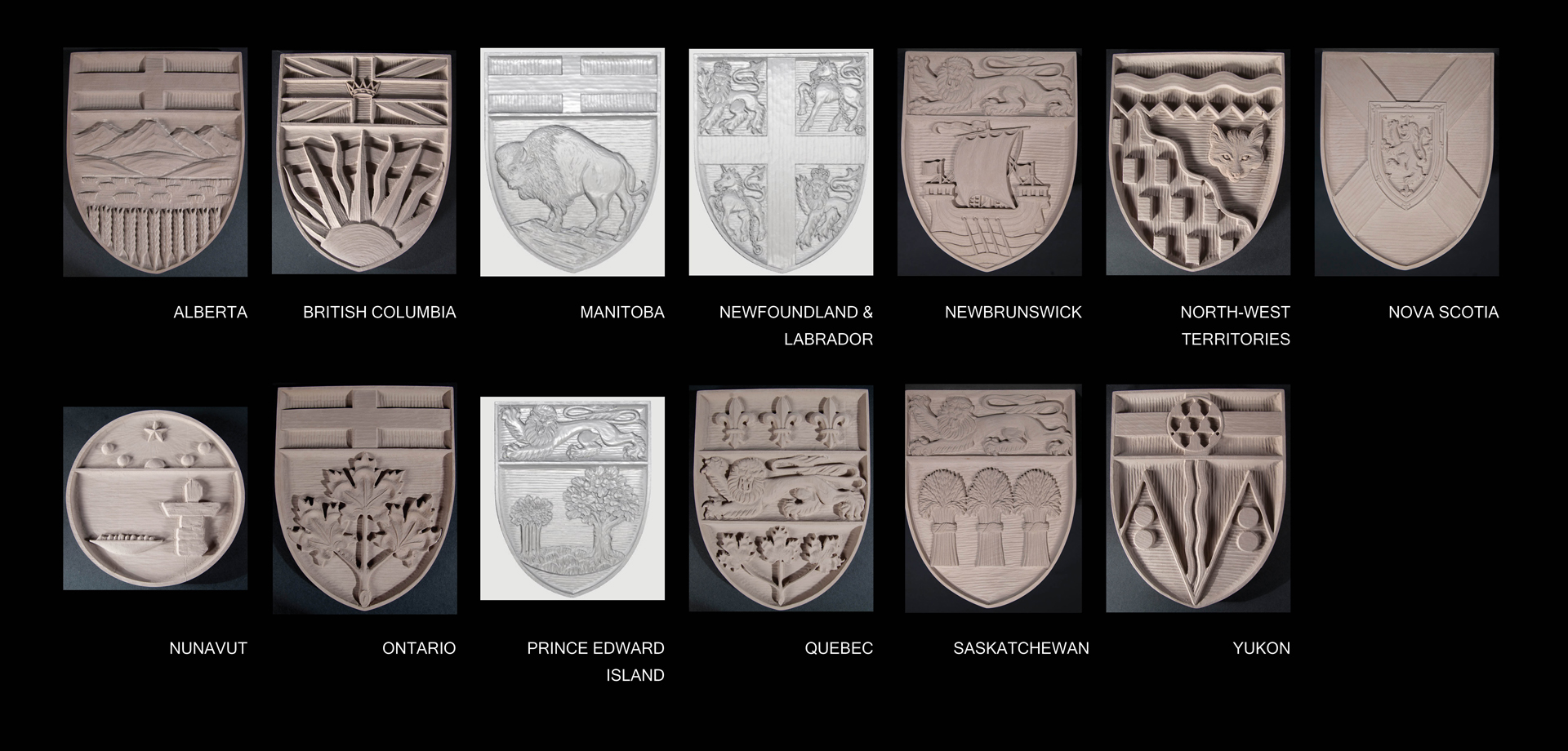
The Provincial Crests of the New Senate Chamber
Lining the walnut walls of the temporary Senate Chambers, located in the Government Conference Centre, are the Provincial Crests of Canada. The creation of the Crests was a collaborative effort between the Dominion Sculptor of Canada, Phil White, and the Digitally Assisted Fabrication team at CIMS.
The original Provincial Crests were carved at a larger scale by White to achieve a high level of detail. The Crests were then digitized by Heritage and Conservation Services (HCS) into meshes. After receiving the digital meshes, CIMS scaled the crests down and used a CNC milling machine to carve high-density foam that was returned to White for final finishing and gilding. Before the final milling of the foam; however, CIMS conducted a series of samples to test out tool paths and milling processes. The greatest challenge of this project was finding a balance between foam density and level of detail. The denser the foam, the more detail it will hold; whereas, the finer the tool and tool path, the more detailed the surface finish in all foam densities. CIMS tested various foam densities and tool paths to determine the correct combination for the final milling of the Provincial Crests.
Before beginning milling, the meshes are processed to level the surface and remove excess material and noise. The cleaner and smoother the mesh, the easier it is to generate tool paths for, and, therefore, the cleaner the surface finish of the final milling. This step is extremely pertinent when dealing with such dense, highly detailed meshes to retain the fine detail of hand carving. After cleaning and preparing the meshes with tooling outlines, the meshes were brought into the software, MasterCAM, to generate tool paths.
Testing of foam density ranged from 15lbs to 48lbs. Beginning with the 15lbs, a workflow template for milling the crests from roughing to finishing was tested and finalized. By practicing the workflow at the beginning, we were able to optimize the production efficiency and avoid any unfamiliar milling techniques when milling the final pieces. This stage of testing also began to familiarize us with formal complexities in the Crests that mandated specific toolpath adjustments.

The next phase of testing increased the density of the foam to 30lbs and 48lbs – the density of the final pieces. Once the foam density was increased to 48lbs further complexities to the design of the tool paths were revealed. The high density of this foam meant that even with our smallest tool (1/16”) the tool path was visible at a 0.2mm stepover - the distance between two passes of the tool path. A 0.2mm stepover is typically used in detail work; however, proved inefficient. Further refinement of the tool path resulted in a stepover of 0.1mm, which had an added concern of files size. The digital files of the Crests were divided into smaller portions to make the size more manageable.
Once the testing outcomes were satisfactory, production on the final pieces began. Each Crest varied in cutting time due to large variations in detail and texture between each design. Production time ranged from twenty to fifty hours per Crest. Once we were roughing and adding in finer detail work, Phil White hand finished each Crest and then applied gold leaf before installation.
If you want to see the Provincial and Territorial Crests in person, go down to the Government Conference Centre and see the impressive millwork first hand. The amount of millwork and its quality would not have been possible without the collaborative efforts of Phil White and CIMS.