
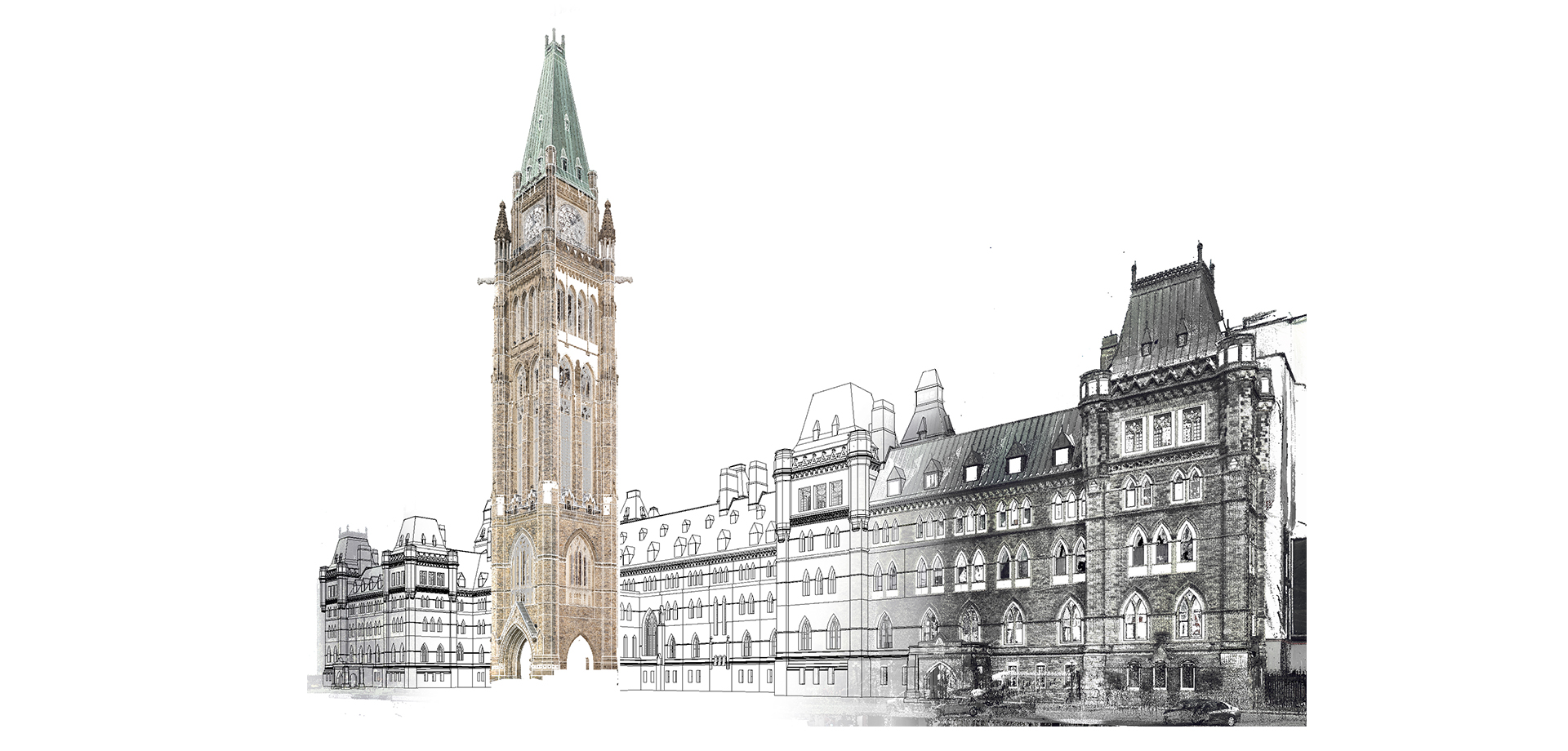
Revamping the Peace Tower BIM
A team of CIMS researchers spent much of 2019 modelling the Peace Tower as part of our Centre Block Building Information Modelling (BIM) efforts. This focused area of the Centre Block allowed us to experiment with new modelling methods and showcase the methods that we have previously perfected.
The interiors of the tower consist of more than 20 levels all connected by stair families that have been modeled to match point cloud data whereas the exterior of the tower is made up of parametric windows and detail components hosted onto walls. All of these detail components, including pinnacles, dormers and rosettes have been modeled in course, medium and fine detail levels which maintains complex geometry while allowing the project to be of a workable file size. Furthermore, all windows have parameters that allow more flexibility when matching the point cloud.
In this series, we focus on how the modelling team modified default family types in order to leverage both the geometric complexities of the building, the need for adjustment to match point cloud data while also integrating a new means of scaling back levels of detail for a smoother performance of the model during the collaboration efforts with CENTRUS.

Peace Tower BIM with highest LOD
After many years of Centre Block building information modeling at CIMS, the coveted Peace Tower clock was finally modeled in the 2019 summer. The clock family has a diameter of approximately 5m and is placed on all 4 sides of the Peace Tower. This unique clock includes 4 nested families which allowed us to join the geometry together while keeping a very simple and organized main family. One main parameter controls the width of the square frame and subsequently the diameter of the clock. As this parameter is increased, the entire clock scales up seamlessly because all detail component nested families are attached via nested parameters. The tedious process of creating this clock was challenging but ultimately led to a very clean family with only necessary parameters. We are very proud of the final result of the clock, and the skills learned on this project have also influenced our other ongoing BIM projects beyond the Centre Block.
 Peace Tower Clock
One of the newest methodologies explored in the modelling of the Peace Tower was to implement a new detail level of detail (LOD) parameter across all of our families. To do this, certain elements in the individual families are classified and visualized according to one of three LODs that correspond to already programmed visibility settings of Revit: low, medium and high.
The low LOD typically shows the general form of the object as defined by simple geometry without depicting much of the specific or detailed profiles that would define it. This low LOD was required mainly for conceptual/schematic planning and for smoother navigation while modelling. The medium LOD shows more detail in relation to the specific profiles but not the fine ornamentation or carving details that would give it a unique appearance. The fine level of detail shows all of the intricate detailing to match the as-found condition of the building including finer details. Typically, this LOD is used for making visualizations and for heritage asset management purposes.
The advantage of integrating this workflow into the model is that now users can lower the complexity of the model to be simpler according to what they are currently working on and faster loading for when a global view of the project is needed.
This workflow helped in particular for families that repeat in many instances such as the many line-based families that make up the facade of the Peace Tower. In a simple click, users can reduce levels of detail to multiple elements vastly improving navigation. In normal circumstances the default line-based Revit family allows a profile to be extended along a 2D line drawn by the user. In our case, this same logic was used instead to repeat stone carved elements across a line. This allowed repeating sets of details to be multiplied across a span.

Example of the 3 levels of detail