
Parliament: A Virtual Experience
On Monday, May 11, 2020, I had a welcoming surprise that Parliament: A Virtual Experience appeared in the Steam store as a new release. As I pulled out the Oculus headset to immerse myself into the beautiful and colourful portrayal of the Canadian parliamentary process, I reflected on the project and my involvement. In fall 2017, I attended the first brainstorming meeting with the Library of Parliament and the National Film Board (NFB) for the Virtual Parliament project that would transform the Centre Block of Canada into a virtual reality experience. For all of 2018, I led a large multi-disciplinary team of researchers at CIMS to transform the building information model (BIM) of the Centre Block of the Canadian Parliament Buildings into the stage where the experience unfolded. Now, immersing myself in the virtual parliament experience where I follow along with the narrative in the animated parliamentary spaces, I can finally say that the project was well worth the hard work the team put in.
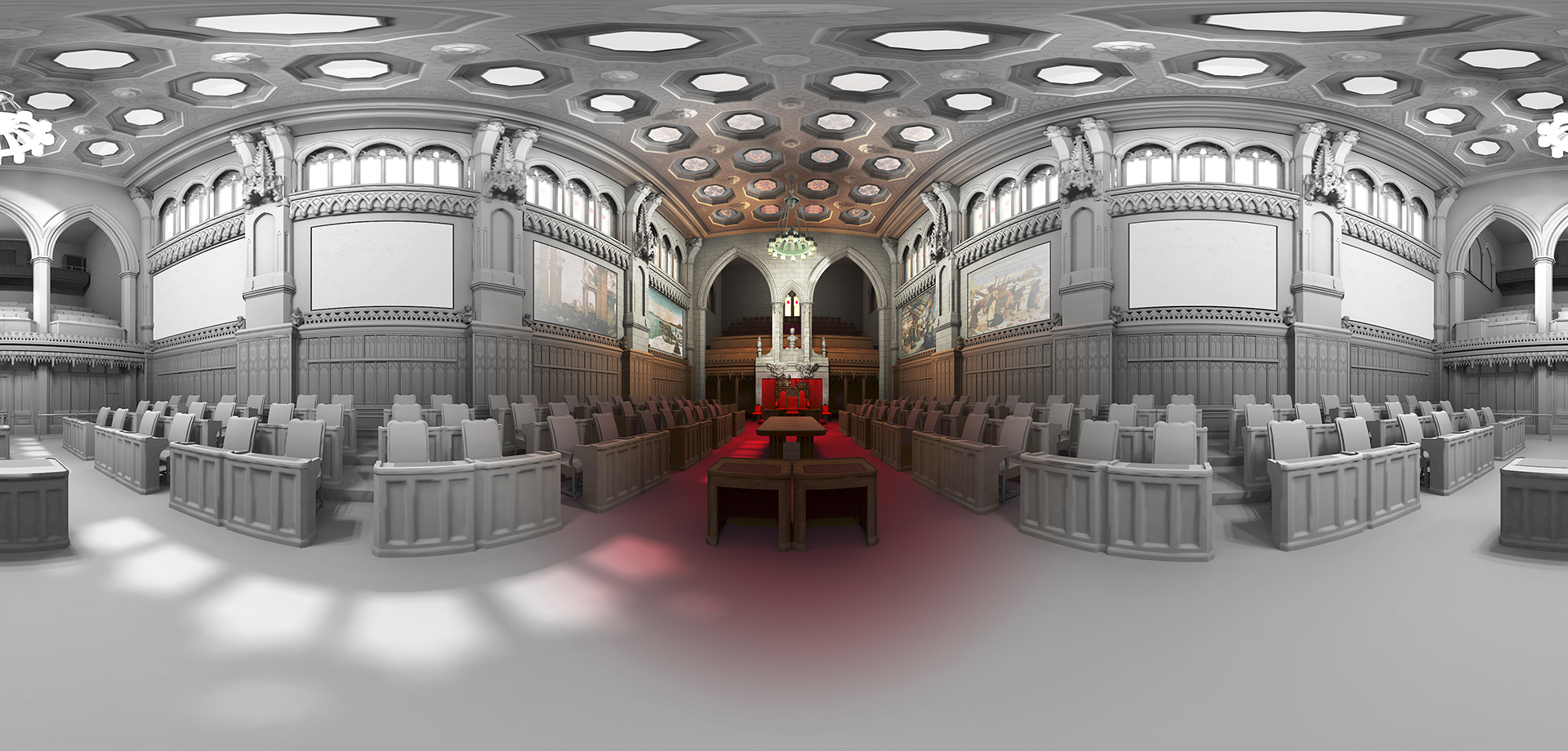
 Animation of the Senate. Credit: Library of Parliament / National Film Board of Canada
As described on the NFB’s project website, Parliament: A Virtual Experience transports the viewer through the iconic spaces of the Centre Block including Confederation Hall, the House of Commons Foyer and Chamber, the Library of Parliament, the Senate Foyer and Chamber, and finally up through the carillon of the Peace Tower. CIMS was brought into the project as the curators of the space. We ultimately created the stage that held the narrative defined by the creative director, Émilie F. Grenier, along with the Library of Parliament and the NFB. CIMS converted the BIM and added photogrammetric data to create a high level of detail of representation of the spaces in Unity 3D that met the requirements for a successful VR experience.
 Point cloud overlaid over the Library of Parliament BIM
A highlight of the project was working with DPT, an immersive experience studio with extensive knowledge of digital storytelling in art, web, games, and VR. Although CIMS worked independently on the creation of the model, DPT provided guidance and shared their wisdom to help the team at CIMS act more efficiently and collaboratively. The open communication between the two labs ensured that the handover of the model was successful, and DPT could transform the scene into the awe-inspiring experience that unfolded. Projects, where research and industry collide, can always help both sectors improve, as evident with the collaboration that occurred in 2018 between CIMS and DPT.
The success of CIMS involvement on this project can be credited to three main factors – a commitment to project management procedures, fluid communication between team members and stakeholders, and a talented multi-disciplinary team. A large scope and a tight timeline caused stress on the team to ensure that key milestones were met. Retrospectives were a frequent event to ensure that each phase of the project improved from the experiences of the last. The team ensured constant communication with daily updates and tracking of progress. CIMS remained in continuous contact with all stakeholders, ensuring the Unity environment matched the expectations and the time invested went to the elements that were deemed critical to the narrative development.
Most importantly, the project succeeded because of the team. Coming from Architecture, Engineering, Interactive Media and Design, and Information Technology, the group of undergraduates and graduates worked tirelessly to complete the project and created new and innovative protocols for creating a complex process of converting the BIM to VR. The team was dedicated and cared about the project and the team, working late hours when needed and ensuring stress levels remained manageable by socializing inside and outside the lab. When I reflect on this project, I am excited by the final product released, but I am nostalgic for the community that we created while doing it.

Animation of the Hall of Honour. Credit: Library of Parliament / National Film Board of Canada