
NAC@50+ Workflow Breakdown
Celebrating 50+ years of the National Arts Centre, the NAC@50+ project will bring the rich history of the NAC to the public through an interactive storytelling experience, exploring ideas of how a national historic site can take a digital form. Users will be able to experience the NAC from its conception, through its evolution, and into the present. To bring the NAC and all of the stories within it to an online platform, there are many pieces to consider. In this blog, we will be discussing our workflows for re-creating the NAC in Unreal Engine, writing the narratives, and designing the gameplay.
BIM to Unreal Engine Workflow
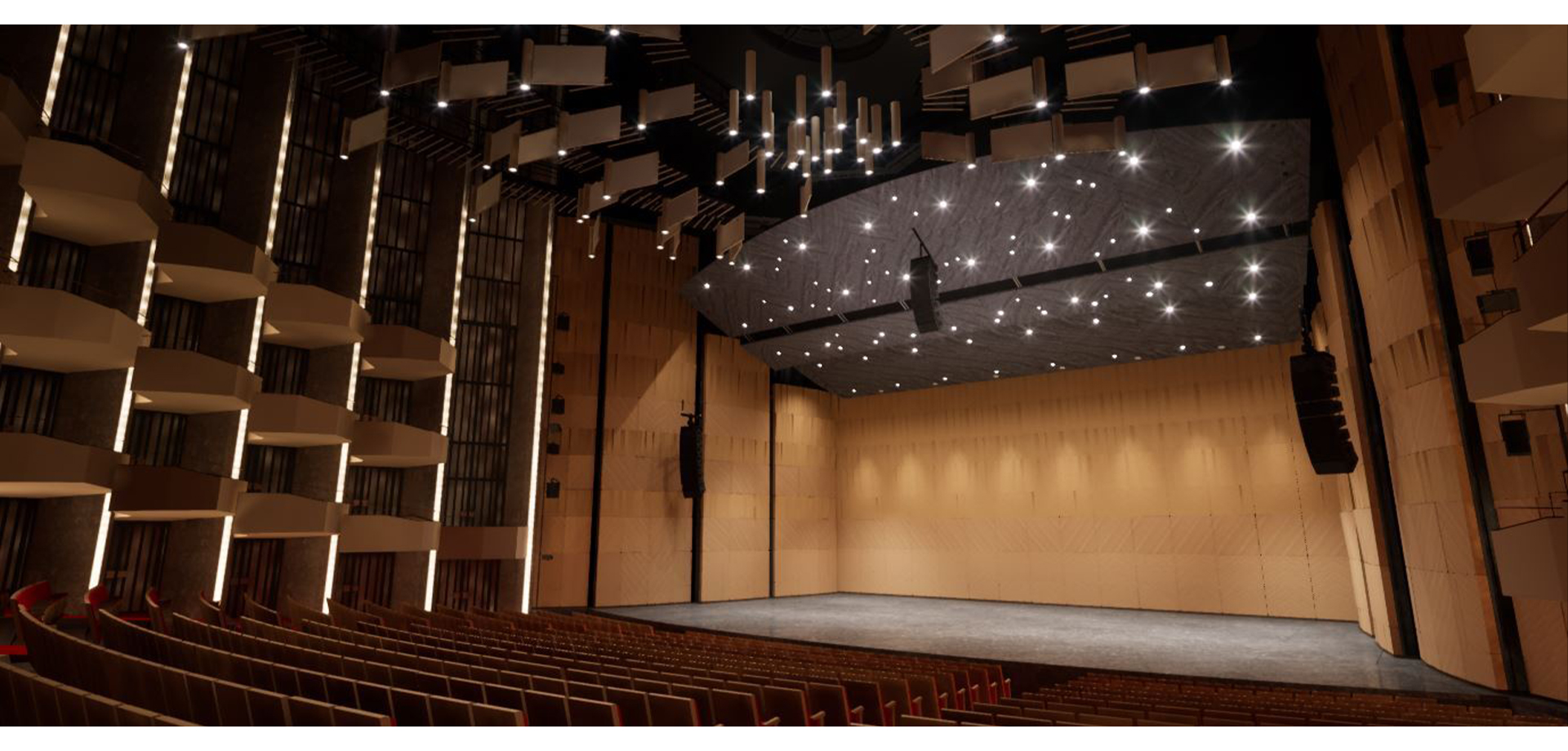
The first step in the project was to create a 3D environment for storytelling to take place in. We began with the existing Revit model for the NAC created by Diamond Schmitt Architects. In order to bring this building information model (BIM) into Unreal Engine to build the experience around, it had to be segmented, optimized, and textured.
During the experience, the user will be taken from room to room through the building, with both guided tour and free roaming gameplay elements. To make sure the building felt complete as the player was exploring it, it was decided that the building would be broken up into streaming levels- a feature of Unreal Engine which allows us to load and unload groups of content depending on the player’s location. This method allows for loading as little content as possible to improve the framerate, without sacrificing the visuals.
 An exploded axo of the National Arts Centre
To prepare the model to be separated into streaming levels, we first had to segment the model in Revit. BIM models are created with a much different purpose than what we want to use them for with NAC@50+, so some extra work is required to get the model set up properly. In our initial tests, we segmented the model room-by-room using the section box tool in Revit. This method worked, however, due to the constraint of the rectangular section box, there were many overlapping elements between rooms, as the building has very few rooms which are perfectly rectangular. If these duplicate and overlapping elements are not removed, they will cause problems when the room is brought into Unreal Engine. A new method for exporting from Revit was put into place, using Dynamo to filter elements in order to get a more precise room export.
Once the room has been exported, the geometry is brought into Rhino and 3DS max to optimize the meshes. This includes merging elements to lower the asset count, re-topologizing elements to lower polygon counts or fix problems in the meshes, and removing any geometry which will not be visible in the scene, such as structural and electrical elements behind the walls and under the floors. We also do a visual check of the rooms compared to our reference photos and add any missing details. Once the room has been optimized, it is brought into Unreal Engine. The final step in Unreal is adding materials and lights to bring everything to life.
Narrative Writing
With NAC@50+, we were challenged with covering over 50 years of history in one game experience. We made the decision early on to split the narrative into three parts; Conception would tell the story of the NAC’s creation and the construction of the building, from 1949 - 1969. Embodiment / Disembodiment would discuss the establishment of the NAC and its transformation into a national network, from 1969 – 2000, the final narrative Rejuvenation would look at the architectural rehabilitation of the building, how the NAC adapted to the digital age, and how it is continuing to evolve, beginning in 2000 and looking into the future.
Even after splitting the narrative into three sections, the stories were still quite long. It was important to us to mention all of the important moments in the NAC’s history, good and bad, so we decided to break up each narrative further to keep as much content as we could, without making the experience too long and overwhelming for the audience. Each of the three narratives were split into three ‘lenses’. The lenses would each examine the time period from a different perspective: an NAC staff member, an NAC performer, and an NAC visitor. The lenses also served an additional purpose- they gave us a natural narrator to tell each story. The narrators would tell the story from the perspective of a staff member, performer, or visitor, however they would remain an ambiguous figure, and would not represent any one person in history.
 A narrative collage from the NAC@50+ project.
The process for writing the narratives began with extensive research; collecting information through official documents, news articles about key events, and as many other sources as possible to build well-rounded narratives with many points of view. The key events were then sorted into the narratives and lenses. The events of the narratives have gone through quite a few iterations in order to keep the amount of content in each lens balanced, while also keeping the story cohesive.
With the outline for each lens complete, we began to plan how each story would fit into the game. Each lens was assigned 4-6 rooms in the NAC that were most relevant to the events for the user to explore during that lens. Assets were selected for the user to find that would enhance the story, including a mix of 3D models, architectural features, images, and documents.
Once the planning phase for each narrative was complete, we were able to move onto the scriptwriting phase, as each story will be fully narrated. Once scriptwriting has been completed in English, it will be translated into French so both official languages can be offered in the experience.
The final element of the narrative writing process is the oral history interviews. We have had the opportunity to sit down with a number of individuals to share their experiences with the NAC. Pieces of these interviews will be included in the narratives to give a personal touch to the stories.
Designing the Gameplay
The gameplay is the final piece to tie together the virtual NAC built in Unreal Engine to the narratives, and add the element of interactivity to the experience. There will be two parts to the gameplay: a guided tour, and an exploration section. The NAC building is large and can be quite complicated to navigate; the guided tour portion will help the user stay on course while still experiencing the building, while also making sure the user only sees the spaces we choose to highlight for each narrative, to maintain excitement at discovering new parts of the building in each experience. The guided tour will also give a fixed amount of time for the narration to keep the story flowing smoothly. The tour will end at one of the highlighted rooms, at which point the user will be able to freely explore the space. A selection of assets will be scattered around the room, and as the user explores, they will discover these assets, which in turn will unlock more of the narrative.
Being an interactive storytelling experience, it was important to us that any ‘gameplay’ or interactivity enhanced the story, and did not distract from it. As the user discovers assets, they are rewarded with more of the story, however there are no points or leveling systems that are normally found in games. A compelling story, beautiful visuals, and curiosity will spark motivation in users to move forward in the experience, and for those who like something a little more competitive, there will be options to share your progress through the narratives and the assets you have discovered.
The NAC@50+ project is now well into its development phase. As we continue adding rooms into Unreal Engine, we adjust our workflows to become more efficient and accommodate new challenges as they arise.