
CIMS Core Faculty: Johan Voordouw
Johan Voordouw is an Associate Professor at the Azrieli School of Architecture and Urbanism and a registered architect (Architects Registration Board) in the UK.
Prior to his appointment at Carleton University, he taught at the Leicester School of Architecture, and London Southbank University in England. He has worked in professional practice in London, most notably at Foster + Partners, in Canada and interned in the Netherlands.
Johan’s visual work has been extensively published and exhibited in Canada, the United States, England, Austria and the Netherlands, including the Academy of Fine Art in Vienna, International Architecture Biennale in Rotterdam, Royal Academy Summer Show London and the Venice Architecture Biennale.
His research interests include digital design practice, new modes of architectural representation, and its connection to fabrication and emerging theoretical discourse. Most recently he attended the Art Omi Architecture Residency in Hudson, New York and was shortlisted with a multi-disciplinary team of academics and practitioners to curate the Canada Pavilion at the 2020 Venice Biennale.
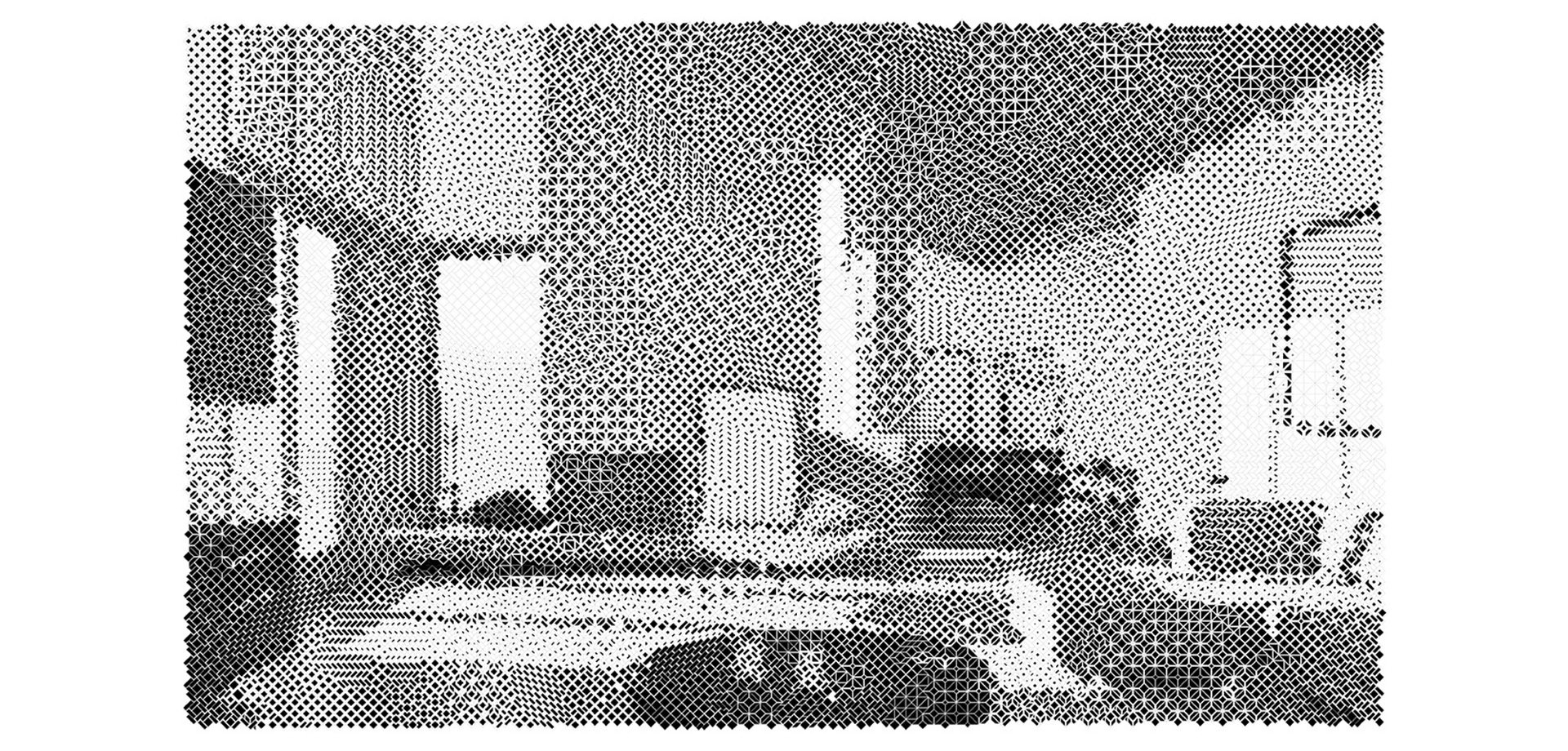
In early 2020, Johan will stage two exhibitions showcasing his New Image of Home project at the Shenkman Arts Centre and the Lightroom Gallery in Ottawa.

New Image of Home is the culmination of two years of research on Canadian domestic interiors. It focused on the single-family homes published in Canadian Architect magazine from 1956 to 2017.
Using these projects, I analyzed the material content expressed in the interior photographs and the evolution of the floor plan. This data informed the twenty-four new drawings on display at both the Shenkman Arts Centre and the Lightroom Gallery in Ottawa.
To develop these new methods of drawing I investigate the dot as the primary element of the digital image. Dots have a more established historical significance in other visual media, but in architecture, they remain unexplored. In this project I sought to understand the implication on the fidelity of the image if I shifted from conventional drawing techniques to more explorative methods. What is interesting about computation is that each dot can be manipulated. I can vary its shape, or size, and overlap. Using dots suggests a number of compelling realizations. The white space between the dots is very different from the white space in a line drawing or a render. It seems that the white space between dots is where all the information, all the fidelity likes to hide. In exploring the dot, it was an opportunity to work not only of the image, but the very visual element that makes an image.

Regarding content, I became interested in the home as represented in design magazines and sought to convey domestic space as an expression of daily life. The background image for a number of drawings is the same to demonstrate the breadth of my ideas. What is important however, is that the drawings challenge the idea of the perfect, curated image. In this home there are cups left on the coffee table, toys under the television stand, laptops and other devices strewn around. All of these things are visible, but the method of drawing makes them fuzzy, hidden, ghostly. In technical drawing every line is consequential. They detail how something is to be built. In a render every pixel is illustrative of what something should look like. Here the image is far more variable, and yet I hope that it asks the imagination to produce far richer reading of contemporary domestic space.
