
Imagining Canada's Digital Twin
I recently watched "The Matrix" wondering if it was really as good as I remembered. I saw it when it was first released, back in 1999, and it has left an impression on me that has persisted ever since. I haven’t stopped thinking about that crazy idea of living in a simulation that was so immersive it was believed to be real. Only this virtual environment was built by computers for humans to inhabit, replacing the real world with a digital one.
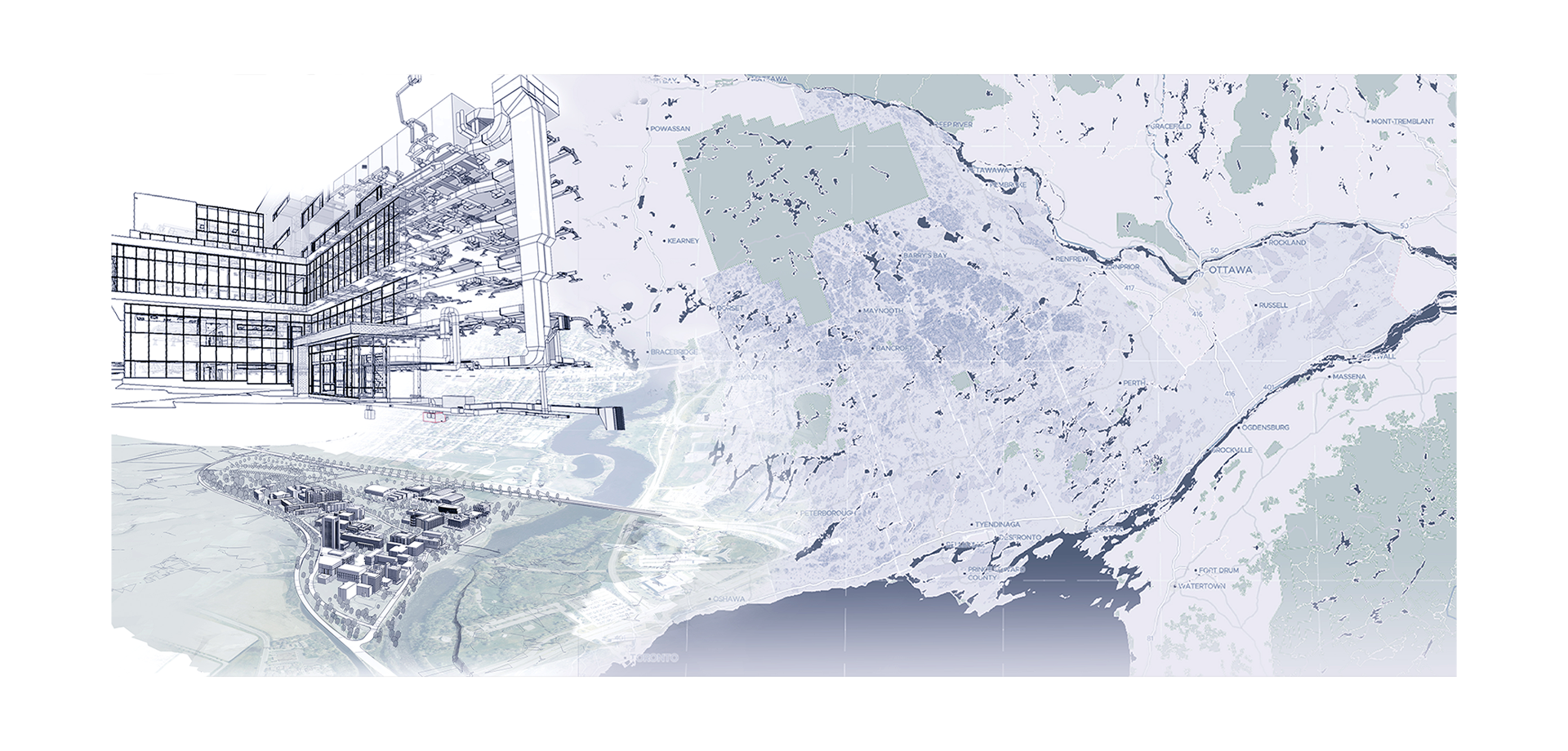
 From building to campus to region: the HVAC system from the Canal building BIM, the Carleton Digital Campus model and a map of Eastern Ontario from the OE3D project.
With the current conditions of the pandemic, I found myself daydreaming about "The Matrix." If only I could share a meal with my friends or get a hug from my mom - I don’t care if it’s in a virtual simulation, that would be welcome and more real than facing a bunch of video feeds on my laptop, waiting for my turn to speak or muting my laughter so as not to interrupt the stream of solo audio. This system of communication is especially foreign to me as someone who uses their whole body to express themselves. As a builder I create using my sense of touch and my visual perception. With architecture, it’s a full-body, sensory experience. My interaction with the world means feeling the sun (and cold, especially in Ottawa), smelling and tasting the air, and hearing and embodying the environment around me.
When I first heard the term digital twin, "The Matrix" was the first thing that popped into my mind. With more research, I realized that a digital twin is something quite different. The term was coined by Dr. Michael Grieves in his product lifecycle management course, as method for optimizing the performance and manufacturing of a product.
 The components of a digital twin using a building as an example.
A digital twin requires three parts: a physical product, it’s digital equivalent, and data connections between the two, forming a feedback loop. An example would be a building in the physical world, such as the Canal Building on the Carleton University campus. The Canal building is equipped with sensors that connect it to its virtual version, a building information model (BIM). Combining BIM with the Internet of Things means information like building occupancy, electricity consumption, heating, ventilation, and air conditioning (HVAC) or other systems, can be monitored and managed more efficiently. By collecting data from the actual building, we can visualize that information in the BIM, in real-time, and make changes to improve building performance, and effectively manage the entire ecosystem.
Currently, digital twin technology is being applied to many different industries all over the world. It was originally developed for product design, but that has expanded to include things like buildings, transportation systems, and even entire cities. Places like London, Singapore, and Helsinki are using digital twins to optimize how their city is managed, make cities “smarter”, and in some cases, even use it for virtual tourism. These are just a few examples of digital twins at a city scale but what if we take that further? What would a digital twin of a country look like? What about a digital twin of Canada?
 From region to campus to building: the greater Ottawa region, a diagram of the energy consumption from the Carleton Digital Campus model, the Architecture Building point cloud and BIM.
This was the question CIMS and our co-applicants proposed in an application for the New Frontiers in Research Fund. The Exploration grant funds high-risk, high-reward research. The project, Imagining Canada’s Digital Twin (ICDT), is the exploration of the idea of a digital twin of Canada. Together with professors and researchers in academia, industry experts, and other interested groups, our aim is to imagine what a digital twin of Canada could be. We are establishing a national, inclusive, and multidisciplinary research consortium for developing the technical, cultural, and ethical framework for building Canada’s digital twin. Our goal is not to resolve the question of a digital twin for Canada, but to determine its feasibility. What would be required to see it realized?
This initial phase of the project involves exploring the idea of a digital twin for the architecture, engineering, construction, and owner operator (AECOO) industries, but our scope is not limited to the AECOO. Our goal is to imagine Canada’s digital twin, which involves opening our imaginations to all the possibilities of what that could mean. This is an opportunity to explore concepts beyond what exists now.
What if Canada’s digital twin could go beyond performance optimization and infrastructure management? What if it could be an access point to gather information and statistics to better understand the needs of the people living in those areas? What if it could be a place to gather, safely and inclusively, during a pandemic? What if it could be a means for exploring and connecting with people and places that we are unable to reach; or maybe sharing stories and experiences in a new way? What if this could be like "The Matrix", only we can choose to inhabit it? Right now, Canada’s digital twin could be anything. I’m excited to see where our imaginations take us.
