
Uncovering Barracks Hill and Bytown with Heritage Passages
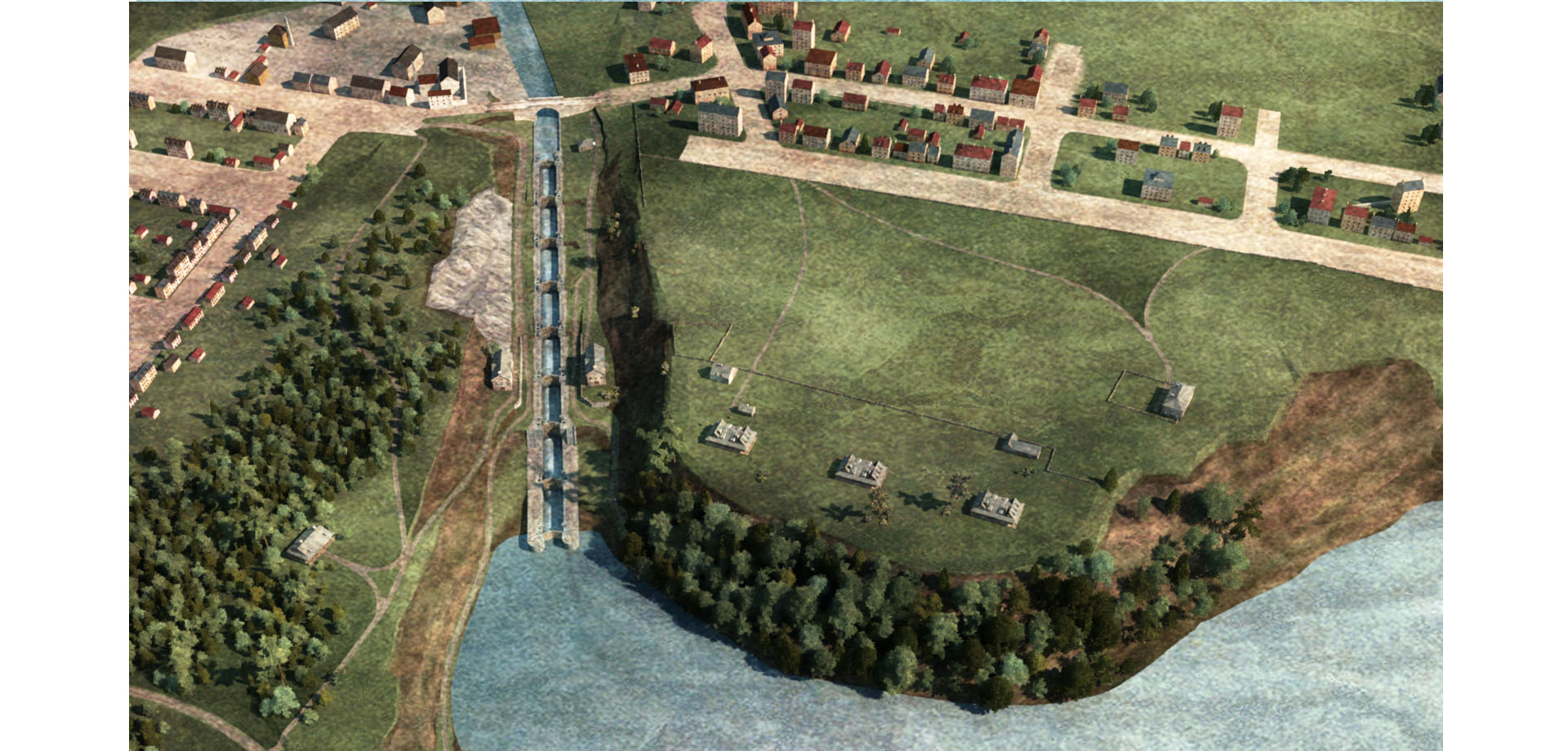
Recently, the Ottawa Citizen ran an article called Parliament Hill excavation uncovers pre-Confederation military complex. Archaeologists are working on Parliament Hill to uncover the ruins and buried artifacts of Barracks Hill – the military base located on the grounds before it became the home of the Canadian Parliament Buildings. In 1857, Queen Victoria announced that Ottawa – formerly known as Bytown – would become the capital city of the new Dominion of Canada. The East, West, and original Centre Block were built on Parliament Hill between 1859 and 1876 – replacing the barracks buildings that had been constructed in 1826 under the supervision of the British Royal Engineers. Today, the remnants of the Bytown era are being discovered, providing more clues to the mysteries of the past. In 2012, Carleton Immersive Media Studio (CIMS) helped develop a virtual museum that focused on the early settlement of Bytown between 1817 and 1860 – including the construction of the Barracks Hill buildings and the Bytown Locks. The exhibit, called Heritage Passages, amalgamated existing material from artifacts and archival records to create a digital visual record of the past. To celebrate the recent archaeological discoveries at the Barracks Hill site, this blog post will look at this early project and how Barracks Hill, Bytown, and the Canal Locks were documented and visualized by CIMS.
Funded through Virtual Museum of Canada (VMC), Heritage Passages was created in partnership with Carleton University’s Archives and Research Collections (ARC), the Bytown Museum, Carleton University’s Digital Humanities research centre Hyperlab, and web developers Bv02. CIMS’ role in the project was to document and develop the digital content that is displayed on the website developed by Bv02 and through an augmented reality app created by the Hyperlab. ARC gathered the archival information and created educational modules for learning. The result is an interactive and informative online exhibition showing how the British military settlement eventually became the capital of Canada. The visitor can navigate through the intertwining stories of origin, military, architecture, disease, labour, Bytown, and community – following a non-linear and interactive path. CIMS created digital models of the prominent buildings of Barracks Hill, the Bytown locks, and Bytown’s houses and commercial buildings in Autodesk Revit and Google Sketchup.
Historical architectural drawings, paintings, and current terrestrial laser scanning data combined to act as the source for the modelling of the buildings and landscape. The main buildings of Barracks Hill and the Bytown locks were modelled in Autodesk Revit while the remaining buildings used Google Sketchup. Autodesk 3DsMax was used for texturing, rendering, and animations. Adobe Premiere and After Effects created the final animations displayed in the exhibit. The animations and renders are processed to be reminiscent of the watercolour paintings of the era. This visual effect was achieved by adding the texture of a scanned watercolour paper to the animations and rendered images during post-processing.
The content created more than seven years ago is still valuable for research and dissemination. Some of the models appear in the 360-degree video experience – From Yesterday to Today: Discover the Hill ¬– that was shown to the public at the VR Kiosk in 2017. The model of Barracks Hill and Bytown are transformed into a 360-degree panorama and displayed through a virtual reality headset. The scene is brought to life with atmospheric sound and a narrative that spans the history of Parliament Hill from Barracks Hill to the present day.
Although the Heritage Passages exhibit has ended, the information and content will continue to be shared with the public to show how Ottawa, the capital of Canada, emerged from Barracks Hill and Bytown. As more artifacts are unearthed on Parliament Hill by the archaeological team, new stories will appear that add to the existing knowledge featured in Heritage Passages.