
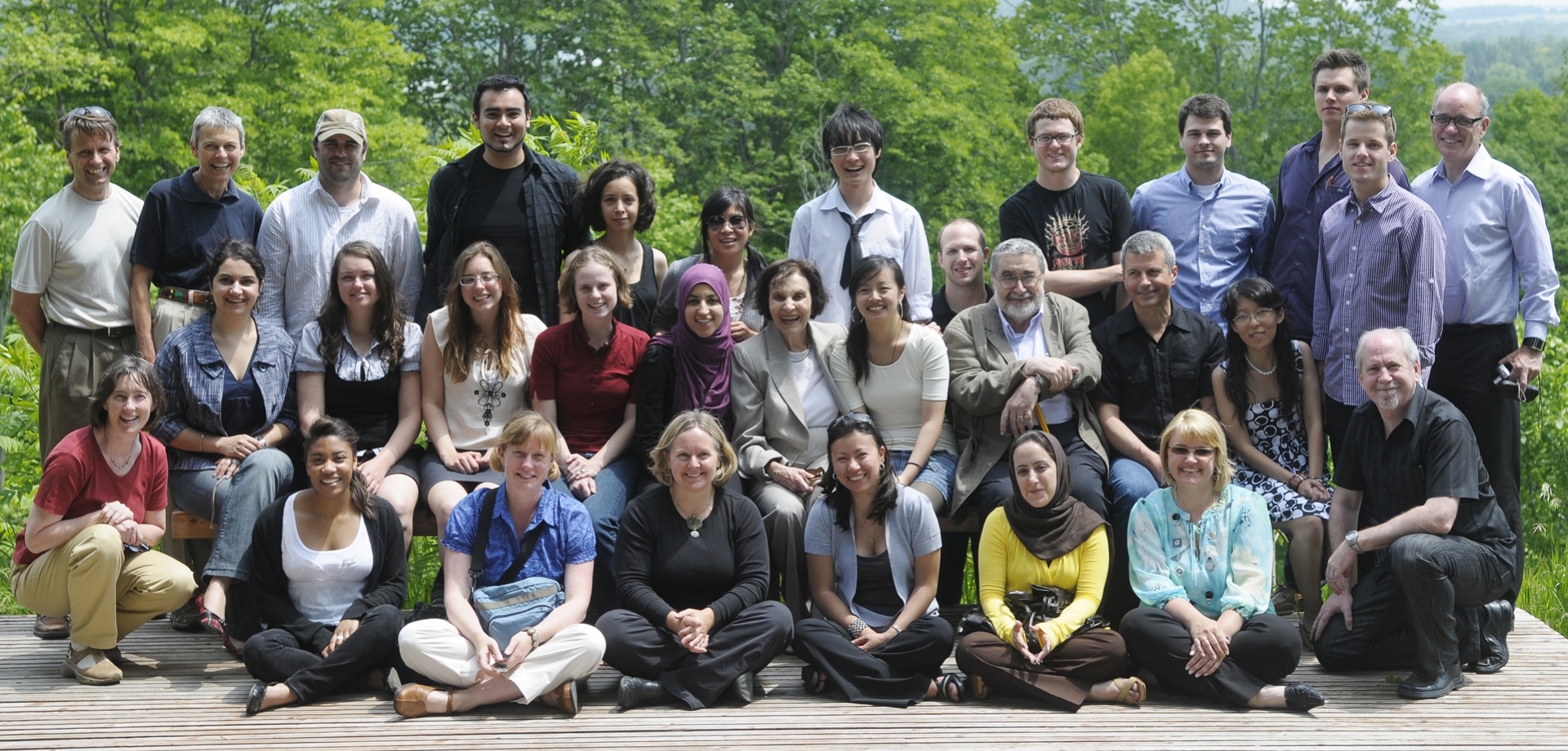
For Sonja Bata: On Trust
Sonja Bata's passing on February 20th was a sad day for me personally and for CIMS as a research group. While Mrs. Bata has been recognized for her work in culture, fashion, and philanthropy - and rightly so - we celebrate her contribution to environmentally and socially responsible community design. I do not claim to be a friend or colleague - but Mrs. Bata had a profound impact on CIMS and the direction of our research program. Her faith in CIMS helped to establish us as one of the first research groups in the world to use building information modelling (BIM) for the recording and management of cultural heritage at an urban scale.
My first meeting with Sonja Bata was on a bitterly cold morning in February, 2009. A school bus full of academics from Carleton University had made the 200+ km journey to Batawa - the one time world headquarters of Bata Shoes. We were greeted by Mrs. Bata on that sunny minus 20 morning with a huge smile and a firm handshake. We were there to discuss her vision to turn the bucolic factory town into an international showcase for responsible community development, environmental stewardship, and adaptive reuse.

In 2008, Mrs. Bata had purchased the village from the family owned, international retail giant Bata Shoes. She enlisted the village as a pilot project in the Leadership in Energy and Environmental Design (LEED) for Sustainable Communities program knowing that a new vision for small communities in Canada was essential for their survival. In 2009, Mrs. Bata invited Carleton University to work with her in designing a "model community" for the twenty-first century. Our first step was an interdisciplinary design exercise in the summer of 2009. This was fully funded by Mrs. Bata through the newly formed Batawa Development Corporation (BDC).

To facilitate the project, Mrs. Bata opened her beautiful Batawa home - designed by Canadian modernist John Parkin - to students and faculty. I had the good fortune to spend a couple of nights under the stunning clerestory windows in the living room. When I asked her if she had concerns about having complete strangers in the house, her reply was "…there are times when you just have to trust people."
<video src="//videos.contentful.com/ujrjk97g2nk9/5YIBYeC0YowkMcU4egUEYM/ab73db1c12dda7e199bf311af79a9bfd/6.Bata_House_Final_Animation_1080p.mp4" controls type="video/mov"> </video>CIMS became directly involved in the Batawa project in May, 2010, through a project co-funded by the BDC and Mitacs Accelerate. The focus of our research was to explore the use of building information modelling (BIM) in the redevelopment of approximately 600 hectares of land with a rich history of modern architecture and town planning. This included detailed modelling of seven buildings owned or operated by the BDC.
<video src="//videos.contentful.com/ujrjk97g2nk9/14NdegwRGgwwky6mGuuoOk/cfc0a489b7f5fa3eab59d0f9d17718fc/7.Batawa_Factory__timeline_Animation_1080p.mp4" controls type="video/mov"> </video>Additionally, over half of the property was a legally protected "Area of Natural and Scientific Interest" (ANSI). While having limited development potential, this protected area was home to a wide range of native flora and fauna. Mrs. Bata was not only sensitive to both the heritage value of the site and the ANSI designation, she hoped to establish a new benchmark for the inclusion of cultural and ecological assets in real estate development.
While our official involvement in the Batawa project ended in 2011, we continue to contribute occasionally with updated files. Mrs. Bata remained interested in our work at CIMS and would call periodically to ask how things were going. She was an amazing human being - intelligent, gracious, generous, and compassionate - never failing to completely mesmerize the students… and me.
Thank-you Mrs. Bata for trusting us. We will be sure to extend that consideration to others.