
Evidence Modelling for the Crown Attorney
With an early project beginning in 2013 followed by three more recent projects from 2019-2020, the purpose of all the evidence modelling projects for the Crown Attorney over the years has been to accurately represent photographic evidence in a demonstrative, digital but non-sensational format, in addition to presenting a clear explanation of the sequence of events of a crime. In all cases, CIMS was contracted because the photographic evidence taken either at the crime scene or postmortem were deemed by the Judge too gruesome to be used as evidence for public and juridical viewing during proceedings. Thus, by non-sensation format we mean to say that the models produced are informed by photographic evidence only as an accurate reference, but that the information is visually transformed to omit the additional shock value and emotional responses they elicit. This aspect is important because it not only gives dignity to the victim but also reduces the risk of PTSD for the judge, jury, and other attendees. These projects thus allow digital tools to hold the narrative and ensure that the court can do its work in a more dignified manner. During the next two weeks we will present four court cases along with the evolution and adaption (from reality capture to custom sculpting to anatomical representation) of our modelling methodology towards the different parameters of each case.
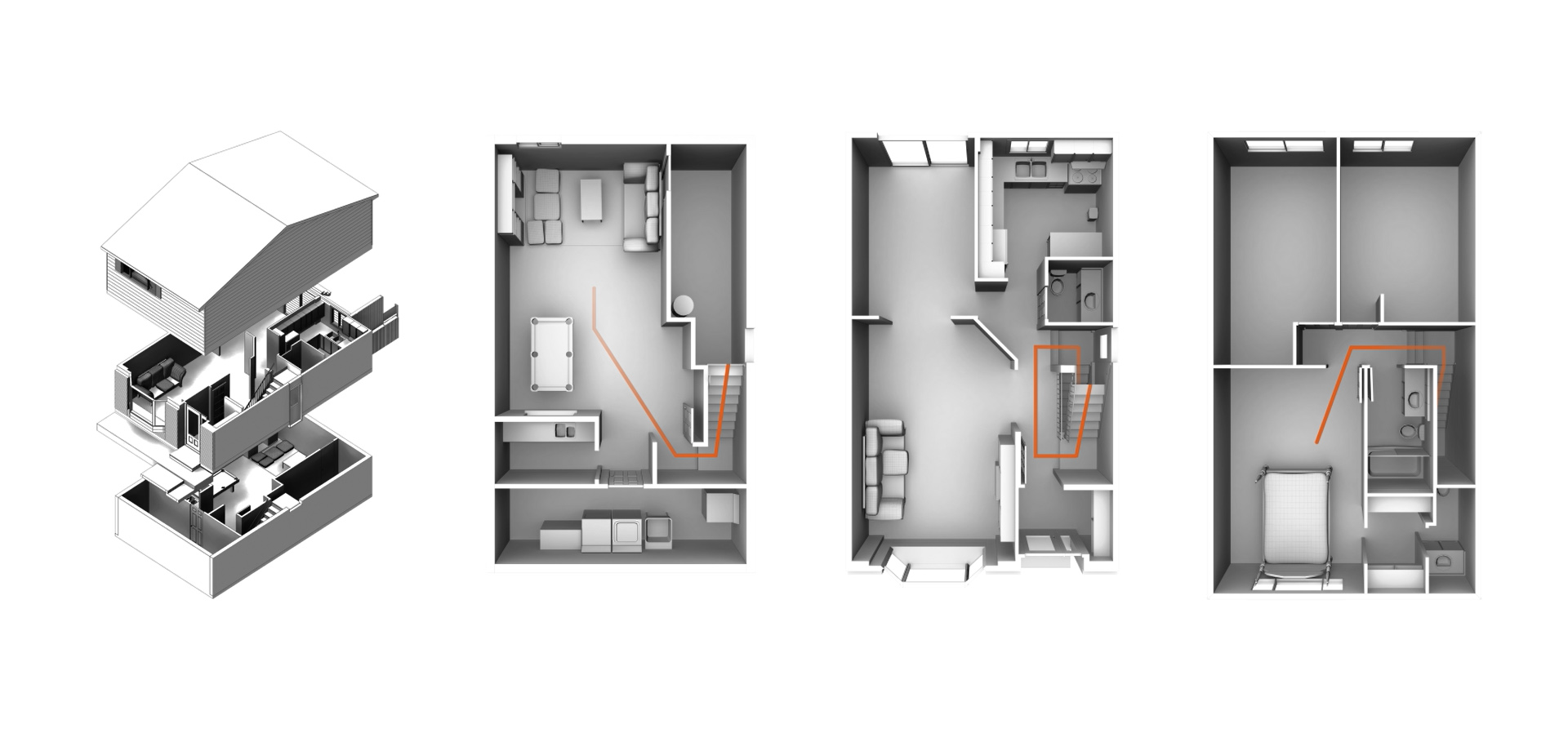
Today, we begin with our first project in 2013 which provided a simple 2D injury mapping of the victim along with the physical path of the perpetrator presented in a 3D digital model of the crime scene. This case ultimately helped us bridge our previous work with the 3D digital representation of architecture in order to model the crime scene itself and reveal the possibility to use 3D representation as a means of storytelling for scenarios beyond the realm of architecture. Given that this was an early project in CIMS’ history, the modelling tools available for the task were much more limited. The model was produced with SketchUp and the 2D injuries were mapped with photoshop onto an anatomical representation and printed in a series of transparent layers with help from the coroner’s office to locate injuries in the postmortem report. Despite the 2D nature, the project provided the essential methodology that would be carried through our future projects in different ways.
 2013 Project: Perpetrator path
Given the precedent of our earlier project in 2013, CIMS was again approached by the Crown Attorney in Summer 2019 to create a model for a court preceding; this time focusing solely on the victim itself. In a very short timeline of just three weeks, the CIMS team was able to focus on the evidence of highest priority by selecting crucial parts of the victim’s body to highlight in a series of 3D models. To develop the model, we relied on a series of photographic evidence and post-mortem description. Due to the focus of sequential storytelling of this case, we used photogrammetric models of researchers from the lab to generate various body meshes. The model was exported into a 3D PDF that could be used in court by the coroner to demonstrate the inflicted injuries. The PDF allowed the user to orbit the mesh, as well as turn annotations on and off that matched the coroner’s report.
 2019 Project: Photogrammetric models of lab members
In Fall 2019 we were asked by the Crown Attorney to create a 3D scale model of a victim that included a diagrammatic mapping of all the internal and external injuries in 3D. Here, modelling the entire body was necessary along with modelling of some internal anatomy such as organs and parts of the skeleton. To reduce the shock-value of the photographs, the injuries were abstracted in the model through a series of generic shapes that focused on mapping the injury location and approximate size rather than the exact shape of the injury. Here we also provided a colour coded index according to injury type to present a clearer understanding of over 80 injuries to the jury.
The model was created using online open source meshes modified to fit the proportions of a photogrammetric model CIMS produced of the victim. Photogrammetry was possible by stitching a series of sparse photographs of the injuries together. This process helped us to capture the proportions of the body and the general proportions of the injuries to have a more accurate depiction of the victim–despite the high level of abstraction used in the model. 3D sculpting in programs such as Rhinoceros 6 and Autodesk MudBox allowed us to make the adjustments to the open source models and to create custom anatomy when needed. These tools also helped us in labelling the injuries by naming associated geometry according to their number in the report since in this case it was also important to depict very clearly the relation between internal and external injuries.

The refinement of transparent materials and model navigation was a large obstacle in rendering and presenting all elements cleanly within our customized 3D PDF. The 3D PDF was selected in this case as the best tool because it allowed us to host the model in a secure manner as well as to ensure that it was possible to access the file across any computer.