
Documenting Canada
To celebrate Canada day, 2018, we reflect on a number of Canadian digital documentation projects by the Carleton Immersive Media Studio completed over the last 10 years. During this time laser scanning has played an increasingly important role in the development of architectural documentation and modeling techniques employed at CIMS.
One of the earliest projects to feature laser scanning was the documentation of the Batawa town and shoe factory in 2010. Located near Kingston in eastern Ontario, the town served as an inception point for research using new and emerging laser scanning technology as the basis for Building Information Models.
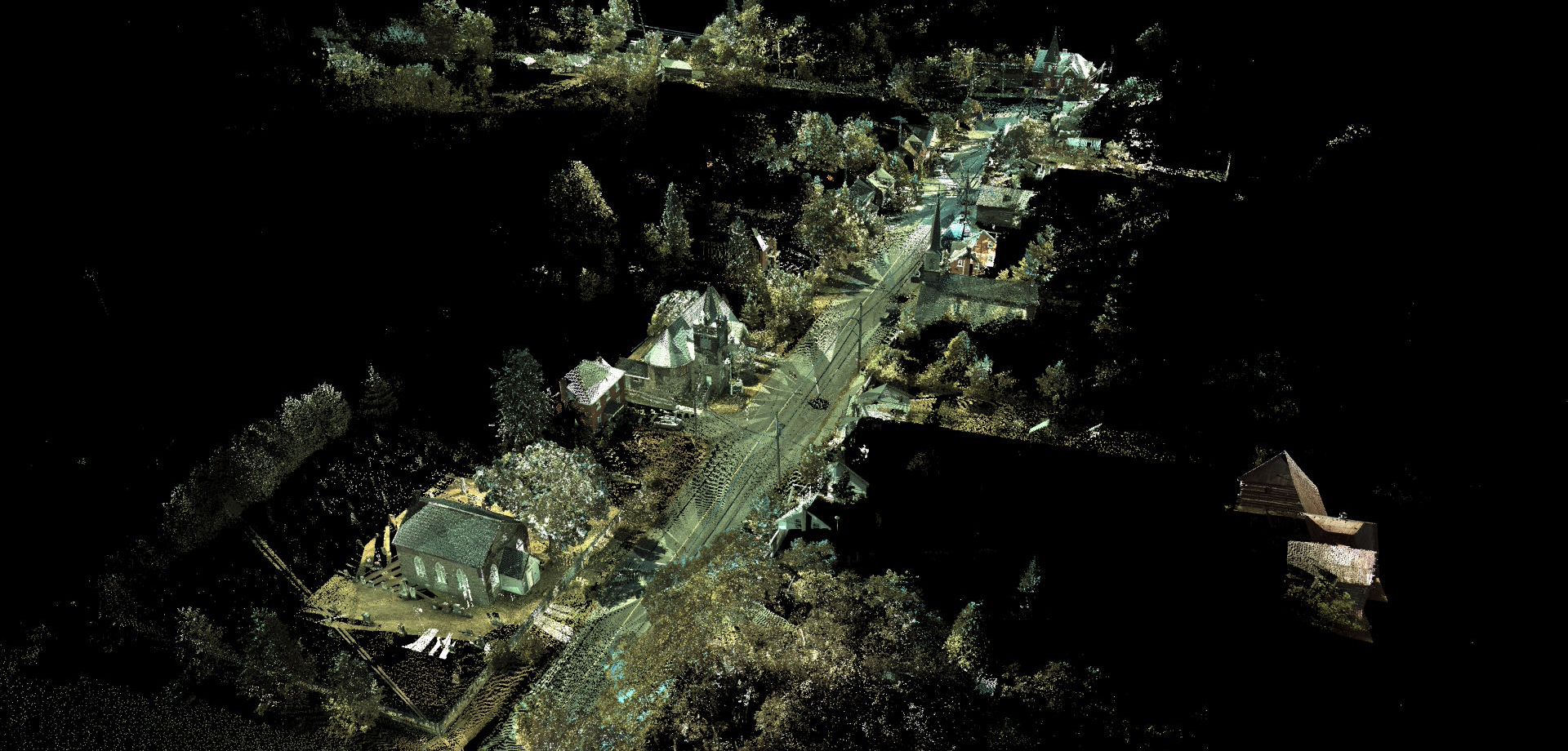
As an expansion of the methods developed in Batawa, ‘Cultural Diversity and Material Imagination in Canadian Architecture’ (CDMICA) is the first project where we really extended how we used laser scanning to capture heritage buildings. For this project, CIMS acquired a new scanner making it possible to capture four to five times as many scans during a day as compared to the previous model. The project focused on the town of Ashton, Ontario with the goal of documenting five unique heritage buildings including two stone churches, a brick church, a log cabin and a historic barn. This project was also significant because for the first time we took advantage of surveying techniques to link all the new data together and accurately tie them to GPS coordinates. Using a digital survey also meant that we could map all the interiors of the buildings to the exteriors and finally to elevations of the entire town.

We later employed similar techniques for the documentation and modeling of the Rideau Locks. The lock scanning project incorporated the locks between Parliament and the Chateau Laurier and the Bytown Museum as well as two other lock stations near Smiths Falls. Models and animations developed from the documentation are available here.
Finally, the Canadian Parliament Buildings represent one of our largest and most significant laser scanning projects to date. Employing both a new Leica P40 scanner and the same C10 that we had used in Ashton and the Rideau Locks, we began by scanning the exterior of Centre Block and West Block. The quality of work produced eventually led to documenting and modeling significant spaces on Parliament Hill including the House of Commons, the Senate and the Library of Parliament.

The many projects developed at CIMS continue to demonstrate the potential to challenge standard documentation practices in architecture. Making use of new and evolving technologies, we continue to research and develop digital documentation techniques by publishing and presenting our findings.
Happy Canada Day!