
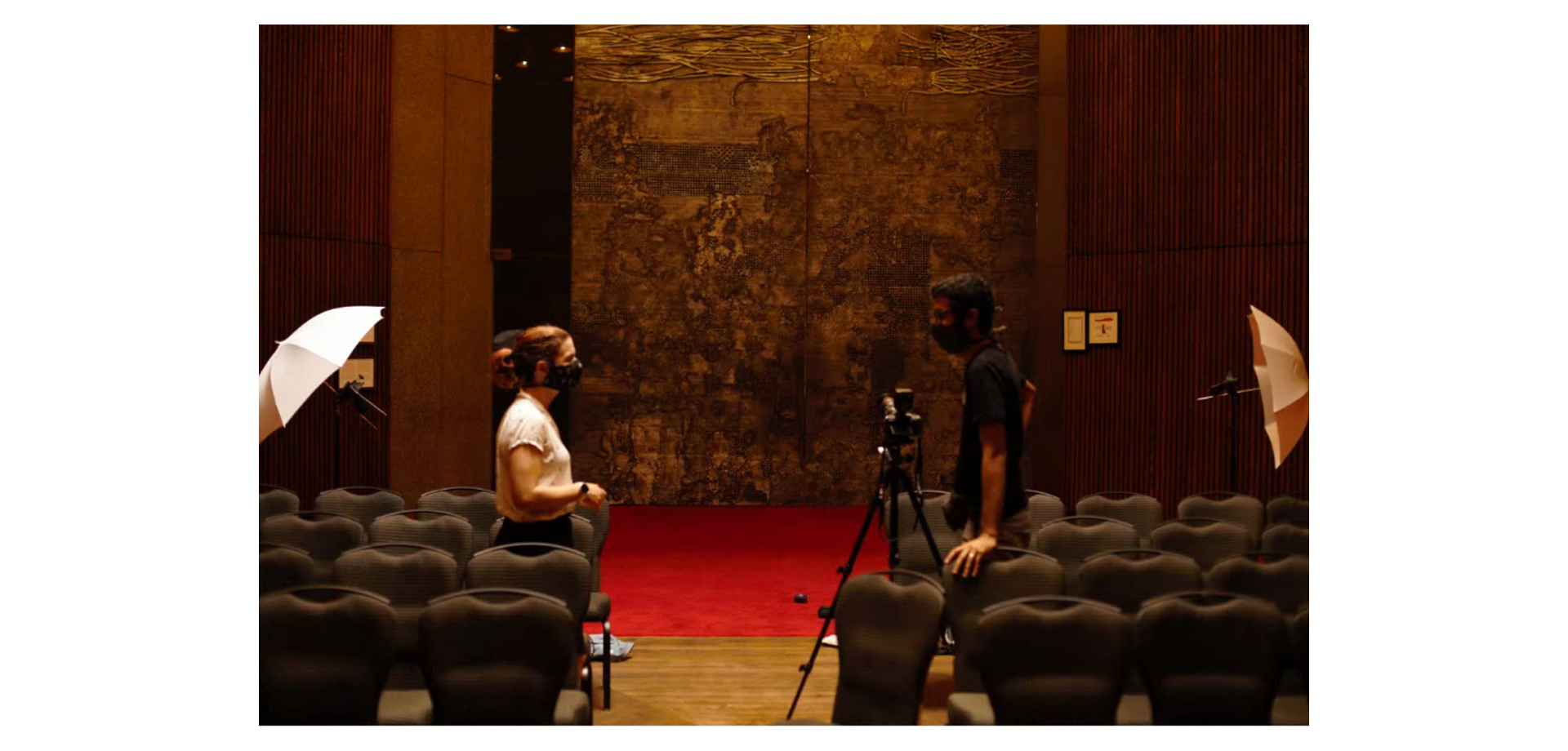
CIMS Interview Series: Katie Graham
Former CIMS researcher and team lead Katie Graham is now a CIMS associate faculty member as she was brought on as an instructor for Carleton University’s Bachelor of Media Production and Design program. I just so happened to be part of her first class in that program in 2019, I thought she was cool then, I think she is really cool now, and most all of CIMS would likely share that sentiment. Katie was the team lead on the award winning “Parliament: A Virtual Experience” project, among many others at CIMS, she’s a mom of two (four counting her beloved cats), and she appreciates campy movies more than most people I’ve met before. That last fact may be polarizing as to whether it’s a positive or negative thing, but Katie’s track record at CIMS and trailblazing instruction in the BMPD program is not. It’s inarguably epic. So, without further ado, a conversation with CIMS associate faculty member and BMPD instructor, Katie Graham.
Everett Rama: Hi Katie! If you never worked with CIMS, what do you think you’d be doing right now?
Katie Graham: This is a hard question. I’ve been involved with CIMS for so long. I guess I kind of see two different areas that I could’ve split off (into) and never encountered CIMS. The first one is from my first year of undergrad before I went into architecture, I actually went to one year of cognitive science. So if I went in that direction, who knows, maybe I’d be working on, like, artificial intelligence. Of course, maybe then I’d still find my way back to CIMS somehow. The other (split) was actually when I took the job at CIMS. It was a co-op position so I was actually offered another job at the same time and I had to choose. I had to choose between CIMS and a job with the NCC. It was a pretty interesting job! It (involved) working on Lebreton Flats development. So I hummed and hawed and decided in the end to do CIMS. I think really what (choosing CIMS) did was make me have an appreciation for research, whereas if I had done the other route I would’ve gone along a different path and followed the more “typical” architecture path and been a practicing architect now.
So, oddly enough, you would’ve ended up as an architect if you’d not joined CIMS?
Exactly!
That’s awesome.
Clearly, I’d be a famous architect and you’d see a building and go “Oh that’s a Katie building”
“Oh that’s one of those Graham buildings you can see it in the design.” Epic jokes, guys What do you think is the most important or impactful thing that you learned while at CIMS?
I think CIMS really gave me an appreciation for the idea of research through creation. Before CIMS, I never really thought of myself as someone who enjoyed research per se, but then when you start to work at CIMS you start to realize that you get to do research through the act of pushing the boundaries of technology and that’s really what I think I got from CIMS; this appreciation for asking questions and saying “I don’t think this software can do it, but I bet I can make it (do it)”, and you keep pushing in that way. Actually, just the idea of research creation is really great too. I never even knew that as a term until recently. I think it’s such a great idea. This idea of solving your problem through the actual act of doing things and figuring out the answers to the questions you have.
So it’s like rather than seeing what someone else did, you just try to figure it out for yourself. While also using other research that exists already I guess?
Yeah, you still do the research. With CIMS projects we’re always trying to figure out what new things we can do or how we can push the boundaries on the technology that we have. You look at what exists in there, you take that and go “fantastic, I know where to start. Let’s push a bit more.” Really what CIMS has done is given me that love for research and asking the questions and trying to find the answers.
Nice. That is very cool, and I’m glad that that’s something you learned from CIMS. From what I’ve heard, you can confirm or deny this, you basically brought digitally assisted storytelling to CIMS; that was largely something you contributed to CIMS. With that in mind, what is the project you’re most proud of that you’ve worked on with CIMS?
I definitely am not the sole person responsible for digitally assisted storytelling. Of course it’s a lot of Stephen Fai’s ideas and his projects, but I do agree that I’ve been a part of the digitally assisted storytelling department since it started in some ways. The two projects (I’m most proud of) that come to mind are very different. They’re actually the first and last projects that I worked on as a researcher. The first one involved modelling 3D mouse brains. I made a 3D atlas of a mouse brain from serial sections. So the mouse brain was cut and then they scanned it and traced the shapes, because I had no idea what a hippocampus was. Then I took those tracings and created a model out of it, an atlas. It was incredible because I learned a lot about the anatomy, and through that (project) they figured out that there was actually a skewing that happened through the slicing and they had corrections of what the mouse brain actually was like by identifying that skewing. It was with the Neurolipodemics lab at Ottawa U (University of Ottawa). The other project is “Parliament: A Virtual Experience.” That one was an incredible project to be a part of. It was probably one of the largest projects for digitally assisted storytelling that CIMS was a part of up until more recently. It was such a fast-paced project and it had some amazing partners. We worked with the Library of Parliament, the National Film Board, and DPT, they’re a digital media company from Montreal. We created the environment for the virtual experience that people can now access instead of going to the building. I think what was fantastic about that project was the problem-solving and the work ethic of everyone on the team. We figured out a lot of different scenarios there as a team and worked together. The project was only as good as it was because everyone contributed in this high degree in what they did, but also in their skillset and their knowledge and thought process.
Any time you’re on a really good team it must be a really good time. I love, too, the scale of those two projects. It’s funny how your first one was a literal mouse’s brain and your last one was Parliament.
It also (went from) me working alone on a project in Steve’s office in the architecture building to one third of the lab at CIMS which was (the Parliament) team.
Bit of a contrast there as well. That’s awesome. Is there something you wish you did differently in retrospect? Not necessarily with those projects, but is there something that you’ll still think of to this day like “argh I wish did I this.” at CIMS?
When it comes to it, any time something comes up that you think that you should’ve done differently there’s a reason you did it that way to begin with, so you should never second-guess. If I really did have to second-guess, I wish that at the last Christmas party, I picked a different orange from the bag to play Orange RollTM because the one I got was lumpy and I was totally set up for failure. Orange Roll is a CIMS Christmas Party tradition involving rolling oranges on a tabletop towards a hole in said tabletop. Kind of like a mix of bocce ball and golf but way more acidic and way (way) more epic. It’s a big deal.
__Yeah, that’s not fair. I’m sorry that that happened to you. __
It’s actually why I left. Sarcasm ^: Can someone please come up with a way to convey sarcasm in writing?
I believe you, and I think that was completely warranted. Sarcasm ^: Seriously.
I was wronged.
What do you miss most about the lab? I guess physically working there, but also it being your day-to-day.
I miss the people, and the sense of community. There’s something about CIMS, it’s alive. Like when you go into CIMS on a regular day and you go into, let’s say, “The big room” and then all of a sudden there’s a whole bunch of axes lying on the back because someone’s doing a research project where they’re taking photos of axes. Or you go and you see all these other artifacts. All of CIMS, not even just the people, is like a cabinet of curiosities of heritage and experimentation and documentation. Just really kind of the evolution of technologies that we’ve tried. The people too, it’s just amazing to sit down with them and hear about someone’s interest in making pasta to someone else playing the piano randomly. It’s an amazing and alive experience to be there.
It does sound great. We talk a lot about how multidisciplinary CIMS is but it goes past that. A lot of people bring their own (thing) personality-wise. I love that part of CIMS culture. (Moving along) what does it mean to be a CIMS faculty member?
As a CIMS Associate Faculty member, I have a different role (than a researcher) in CIMS projects now. I’m no longer developing them and making them, but I help in a different way. I help figure out how the projects can maybe be used in other ways or what the projects could be. I mean right now I’m still relatively new as an instructor so the role as Associate Faculty is still developing. It’s also about being able to connect the BMPD (Bachelor of Media Production and Design) program with CIMS, so have that be more of a connection and help the CIMS research while simultaneously helping the BMPD education.
Cool it’s like a symbiotic relationship, sort of. Did CIMS prepare you for your role as an instructor in ways you didn’t anticipate?
I think the most unique way that CIMS helped prepare (me)… well there are two. One would be the multidisciplinary approach that CIMS takes to everything. That definitely helps within the BMPD program and being able to focus on what the idea of digital media and storytelling is from multiple different disciplines. That really helps support my role in BMPD. Also, when I was leading projects at CIMS one of the things that I found really helpful was working with the people that were on my team to help them figure out what their strengths were and have them answer their own questions. I’m hoping that I was able to bring that same idea into my teaching philosophy where instead of telling people exactly how to do something, give them the tools and ask them the questions that make it so then they’ll be able to figure out what they want to do and what their strengths are.
Wow, yeah, that’s a pretty big takeaway. Ok this one’s very teacher-y. What was the most challenging part of teaching in 2020 and how are you addressing those challenges in 2021?
I think the obvious answer of the biggest challenge in 2020 was the pandemic. As you probably remember we were creating a physical exhibition (for your final assignment) and it was going to be fantastic. We were going to get so many guests. I had arranged food. I figured out how to get food there, we were inviting people, I was trying to figure out exactly the space… it was gonna be great. Because we were all working on hands-on projects.
Yep, we were basically setting up (physical) exhibits. Everyone had their own exhibit planned.
Yeah like yours was the projection mapping!
Yep.
I even had in my amazon cart the projector that was going to work with you guys it was fantastic! Then the pandemic hit and we all had to go home. We no longer could access the NAC for documentation and everything became a digital exhibition. So that obviously was the hardest.
Yeah, pandemic stuff has been the hardest because it’s been a complete turnaround of traditional teaching strategies (it seems).
I mean (yes), but last year for that project specifically I think we were able to adapt pretty well. The project was fantastic in the end. It ended up being that virtual exhibit onlinet. This year, we knew it was online to begin with. The hardest part in kind of (figuring out) how to adapt this year to the fact that we’re online was really rethinking how to teach. BMPD has a lot of students from all over the world so then it also becomes a question of what is the most equitable way to teach? It became asynchronous, so creating video lectures. I don’t know about you, but I’m not going to sit through a 3 hour lecture video.
It's definitely long, there’s pros and cons but it’s hard to stay engaged for sure.
Frankly I have trouble watching a 20 minute video on double speed.
I think that may be a human experience. I think everyone would agree.
Anyway, what I ended up doing is I made them much smaller. So no video is longer than 20 minutes for the most part but then every lecture has multiple built-in. The other thing too is actually trying to include in my lessons as a way of teaching what I’m actually trying to get the students to do. So create interactive learning modules and use digital technologies and media to really express the lessons but also show examples of what can be done for what we’re learning in BMPD. I also include a blooper reel at the end of each of my videos because I make a lot of mistakes and I have some interruptions by children and cats.
I'm sure that's appreciated by your students. Do you see CIMS having a long-term role in your teaching and if so, how?
I don’t really see a future where I’m not involved in CIMS. I think as I continue to move forward in my career as faculty I’m going to continue to have that relationship with CIMS. I’m hoping to have more integration between the two. I also hope to continue that CIMS benefits from the BMPD program through people who can join the CIMS team from BMPD. Then just hoping to continue to grow (that relationship). I think there are a lot of connections between the mandates of both programs.