
The End of a Different Kind of CIMS Summer
Another CIMS summer has come to an end with most students returning to studies in the fall, some remaining as full-time research assistants and others moving on to do other great things in other great places.
It goes without saying why the summer of 2020 will be one of—if not the most—memorable in our experience. Despite that this summer began with several unprecedented challenges, it has been one of the most successful and largest teams we’ve ever had. This summer 63 employees were working at CIMS, all through a remote desktop application that was promptly arranged in a span of only 2 weeks prior to the summer term.

Continuing projects for this summer included the existing conditions model of the Centre Block and our ongoing collaboration with the Centrus rehabilitation team, developing a model of the National Capital with the National Capital Commission (NCC), and completing Phase 1 of a working prototype of the Ontario East Economic Development Application – OE3D. New projects included three new research grant projects that focus on digital assisted storytelling along with a number of students participating and or continuing their work for the New Paradigm, New Tools program.
Despite the challenges at the outset of the summer, the spirit of the lab continued in new ways that we think will enhance our future ways of working and socializing—with or without the help of COVID. For this week we will recap some of the digital tweaks integrated into our normative lab life.
For the last several summers now, CIMS has practiced the concept of lunch and learn which was continued this summer into a new online format. In our lunch and learns, CIMS researchers offer presentations on a skill they have been developing within or outside the lab that relates to the ongoing research of others or simply to spread general knowledge of topics within the lab and inspire connections. This year we had several practical topics offered by our researchers such as BIM to VR workflows, Dynamo workflows related to automation of repetitive tasks as well as a special presentation on secrets to giving great presentations! In addition, we also extended our internal lunch and learns by tapping into new resources at Carleton University with several workshops offered online in various themes of academic writing. The first series of these external lunch and learns focused on the topic of academic papers that extended into two 90-minute sessions. A second series focused on sharpening report-writing skills, and the final workshop, on Writing Grant Proposals tied the three together. Considering many of our researchers are in the process of completing courses for their bachelors degree, in the midst of writing their master’s or PhD thesis, or thinking of applying to both of these and writing research proposals, the writing workshops also provided useful skills for work outside of the academic context of the lab.
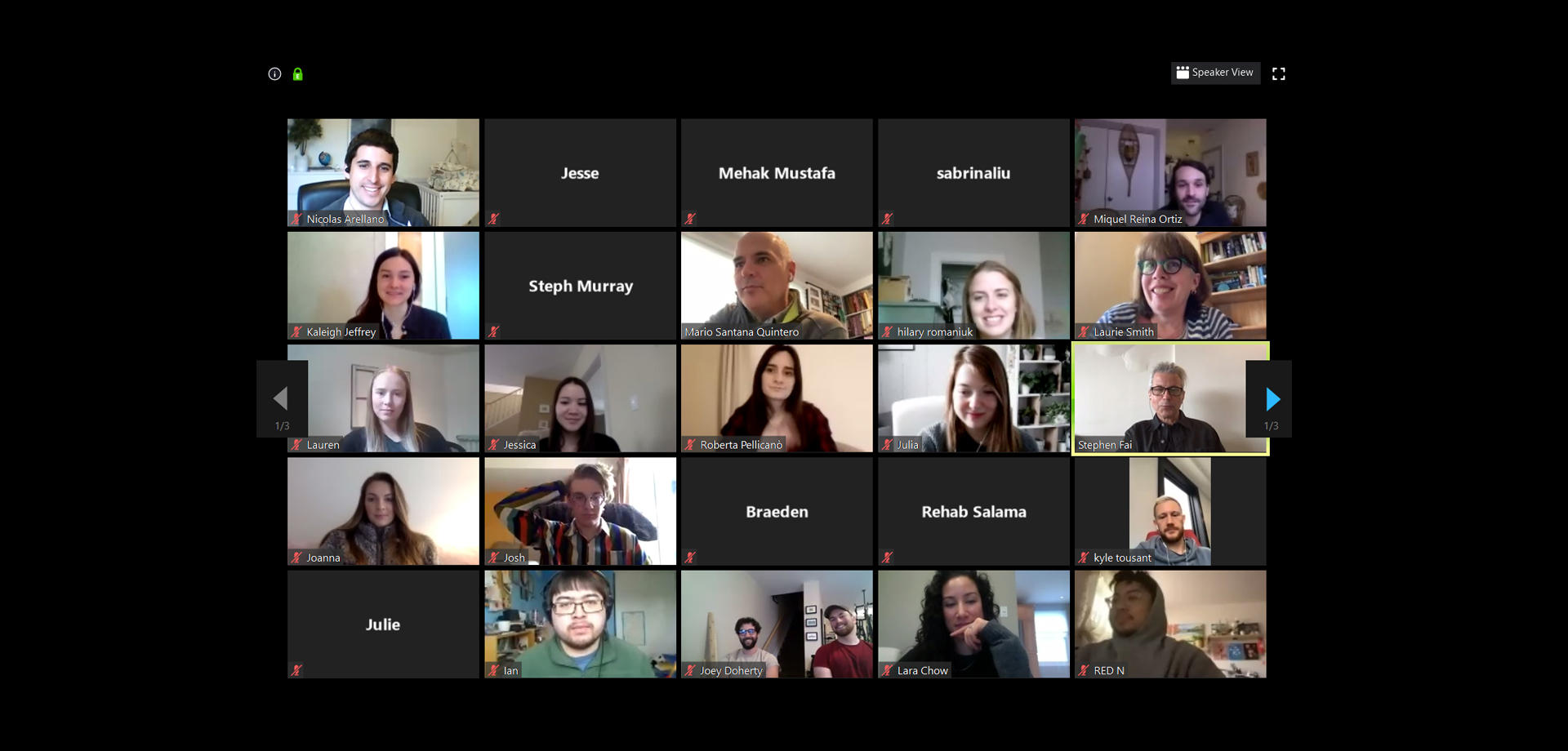
During a regular summer, CIMS researchers gather in a space of the lab, known as “the big room” (it really is a big room) for bi-weekly lab meetings in which we take half of a day to watch presentations and discover the work being currently done on various projects in the lab, to offer suggestions, to make connections between projects and simply to share interesting ongoing work and topics. Being pushed to an online format this year, the structure of the lab meetings also changed in order to facilitate more communication in a setting without face to face interaction. In this new format, CIMS researchers were invited to participate in new ways of brainstorming for CIMS projects.
Throughout the summer, the lab meetings focused on a general research topic or theme - with several CIMS projects presented in relation to it. To facilitate the debate, one week prior to all lab meetings, a series of papers were distributed to all CIMS researchers and a 20-minute open discussion space was left at the end of the lab meetings to ask questions in relation to the readings and/or presentations. For example, for the first lab meeting on the concept of Digital Twin and large-scale urban modelling, the readings engaged specific ideas of that theme, and after a series of open questions and discussions we sought to establish a clearer lab-wide definition(s) of the term digital twin. Other themes of the meetings related to our categories of research included: Digitally Assisted Storytelling and Game Engines, Digitally Assisted Fabrication, Research Grants, as well as Digital workflows in Heritage Recording: Ethical framework and obligations. In all of these, the new structure forged new ways of thinking about our work in larger academic contexts to help situate students in the work they participate in.
Thus, despite the number of challenges this summer, including slow internet connections, construction among researchers’ new workplaces and unwarranted new feline coworkers, the summer exhibited strong resilience to our team members and the general adaptability of our workflows into new ways of living and working in special times. Thank you all CIMS researchers!
Further, a special gratitude for all of this work being possible must go to Ben Daneshgar, our system network administrator. Without him, as Dr. Fai mentioned throughout the summer, it “…would have been a complete disaster for us all without his incredible problem solving skills.” Thank you Ben!