
Reflecting on a Visit to CHARS
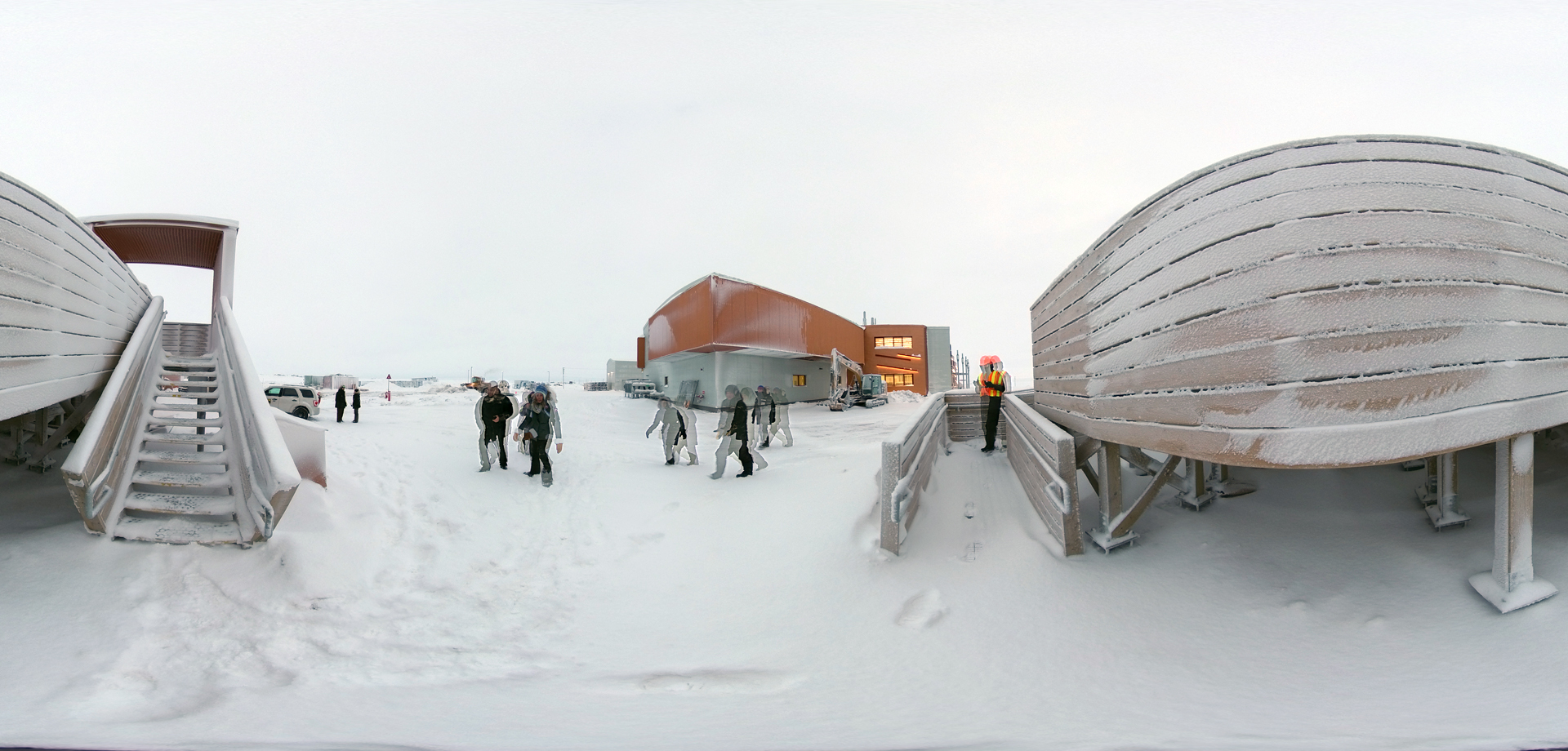
Documenting the Canadian High Arctic Research Station (CHARS) in Cambridge Bay, Nunavut, in late November meant that CIMS team members Abhu Dhanda and Kyle Tousant faced a special set of challenges to overcome.
Very cold temperatures deplete battery power faster, so when working outside, the team frequently had to return indoors to charge their 360˚ camera; however, a cold object brought into warm air attracts condensation, which can damage sensitive gear. Abhu and Kyle’s solution was to wrap their equipment in a plastic bag and wait for moisture to collect on the bag—instead of on the equipment—before continuing with their work.
Winter weather made workarounds a necessity. A snowstorm on the team’s first work day prevented them from entering the main building, since the medical helicopter, required on active construction sites like CHARS, could not land in the high winds. Forced to wait inside one of CHARS’s three researcher residences until the storm passed, Abhu and Kyle took the opportunity to document the interior of the residence before getting the all-clear to enter the main building later that night.

Other challenges were unique to CHARS, a new facility specifically designed to operate in the Arctic. Its environmentally-friendly lighting scheme, which uses LED lights that automatically shut off when they are not being used, made capturing consistent 360° panoramas tricky. The building’s status as a construction site also meant that workers were still employed inside, and that some areas were not yet ready for documentation. Teamwork was needed both between Abhu and Kyle to keep the lights on, and with the tradespeople onsite to prepare locations for data capturing.
Throughout their visit, help was also provided by Jacqueline Lalonde (Manager, Communications and Outreach for CHARS) and Michael Brown (Project Engineer for CHARS), among others to coordinate travel to and from CHARS, give tours and provide information about the building, and ensure the visit went smoothly.
The chance to create a virtual tour of CHARS allowed CIMS staff to not only visit and document a world-class scientific facility, but also to see the important research being carried out in the Arctic, meet the residents of Cambridge Bay, and learn more about life in Canada’s North. CIMS thanks Indigenous and Northern Affairs Canada for this unique opportunity.

Group photo of CIMS researchers Abhu Dhanda and Kyle Tousant with Michael Brown, EIT (CHARS Project Engineer from Indigenous and Northern Affairs Canada), Jacqueline Lalonde (Communication and Outreach Manager from Indigenous and Northern Affairs Canada), Mark Schneider, CD Peng (Project Manager from Public Services and Procurement Canada), and Matthew Hough, P.Eng. (CHARS Chief Engineer from Indigenous and Northern Affairs Canada)