
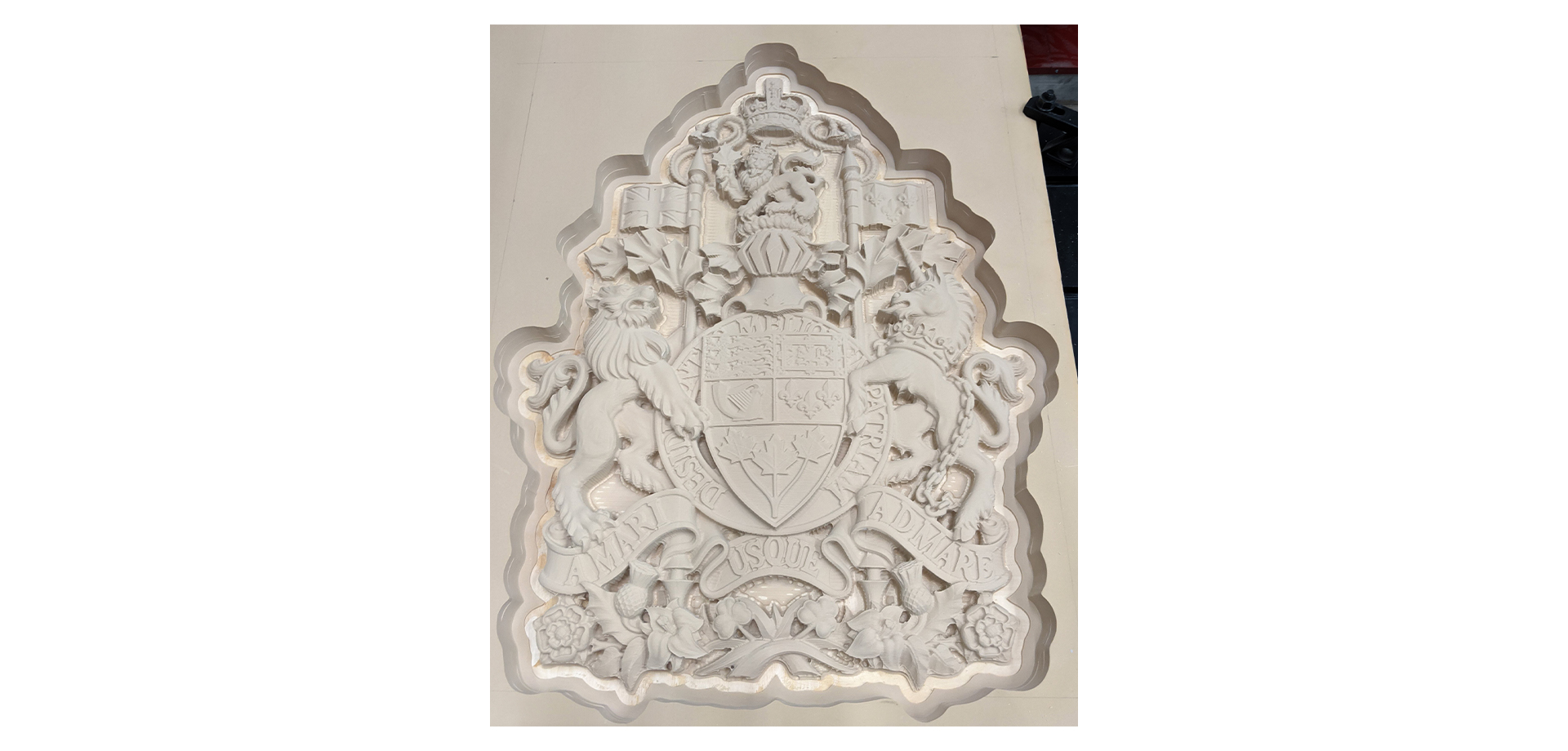
Arms of Canada: 2020
The Arms of Canada 2020 builds on a previous Digitally Assisted Fabrication (DAF) project from 2019. Both projects, past and present, are based on an original design and carving by Phil White, the Dominion Sculptor of Canada, and completed in collaboration with him; working from a mesh of his original carving which was digitized by Heritage Conservation Services Canada (HCS). The mesh was used in 2019 to cut the positive for a bronze casting mold. This 2020 version of the Arms of Canada is approximately the same size as the original hand carving, measuring 36” in height and with a maximum overall thickness of 2”. It is cut from a single sheet of 40lb high-density foam: a directionless material that holds detail in a similar fashion to stone, while cutting with a softness relative to wood; a particular benefit when hand carving. Re-visiting the workflow from the past project, CNC milling and hand carving once again work in partnership in this project. The integration of CNC milling works to minimize the project timeline while placing focus on the beauty of hand carving in conjunction with digital reproduction. The milling portion focuses on maximum material removal and an accurate layout of forms, allowing the hand to focus on details of surface finish, precision, and finesse. The gift of working on a project so similar to the 2019 Arms of Canada is that it gives us an opportunity to improve and expand on our current understanding of collaboration between digital and analog methods of fabrication.
 First Roughing Cut
 First Depth Level of Roughing Completed
Working in the same workflow and with the same geometry as in 2019 also allowed for greater refinements to the relationship between the robot and the hand. The most notable changes were as follows: working to a higher level of surface finish with the robot, the completion of the interior cut-outs by the robot, and the elimination of time spent testing. In 2019 the Arms of Canada was finished with a ¼” ball-nose tool with a 2mm stepover (The size of the tool refers to the diameter of the cutting portion of the tool, in this case ¼”. The stepover refers to the distance between the center-point of the tool as it move along parallel lines. When viewed in relation with one another the tool size and tool path dictate how much overlap there is between each pass, which translates into clarity of surface finish and levels of texture left by the machining). To create a higher level of surface detail, as well as accommodate the scaling down of the form, the 2020 Arms of Canada works down to a finish pass with a 1/8” tool and a 0.5mm stepover. The interior cut-outs (moments in the design of the Arms of Canada where the form is perforated by holes which do not reach beyond the outside edge of the form) were not done by milling in 2019, a decision primarily made due to concerns about the rigidity of the form after milling during transportation. However, doing the interior cut-outs by hand can take up to a week. With the robot integrated into the ½” tool parallel lines passes however, it took just a single day of milling. Time spent milling tests was completely eliminated from the project in 2020 because we were already familiar with the existing geometry. This cut down on project time first because no more testing was needed, and secondly there was already an existing basis for toolpaths to work off of when programing the project. These tweaks to the milling process allowed for the piece being finished by CIMS to better suit the hand finishing process. In addition, many of the physical challenges from the first Arms of Canada were lessened by the reduction of size from 2019 to 2020: the total depth is much shallower making toolpath generation and tool selection easier.
 Roughing Completed
While revisiting the workflow allowed some areas to become optimized, the added detail of the 1/8” tool finishing pass changed the overall milling time drastically. The smaller tool and accompanying tight stepover rapidly approaches the point between negative and positive returns from the CNC milling. There comes a point where the robot is slower and less precise than carving by hand. This point occurs at high levels of surface texture and detail, particularly when combined over very small surface areas. On the other hand, the power of the robot and spindle can be leveraged to remove large areas of material, punch or cut holes through the material, and precisely lay out copies of pre-existing (digitized) forms, faster than through analog methods. The distribution of milling time between the 2019 and 2020 projects was reversed between roughing and finishing. While the much larger sculpture in 2019 only took thirty hours to mill, the sculpture milled in 2020 took seventy-five hours due to the finer tool size and stepover of the finish pass.
 First ½” Pass
 Transition from Roughing to ½” passes over Lion
With their rapid level changes and undulating geometry, one of the greatest challenges of collaborative DAF projects working from original hand carved sculptures is that the hand carved geometry can be difficult to encapsulate in a single toolpath (or very few toolpaths). The complexity of geometries leads to the segmenting of the toolpath with increasing degrees of detail depending on the tool size and stepovers. More experience programming this geometry meant that the time around the toolpath design was able to become more efficient and precise in its programming. Larger segments for the roughing (which was also segmented by depth layers to allow for dust management) were then further subdivided typically into eighths, with each smaller tool size until the finish pass. For the finish pass the toolpath segments needed to be divided in relation to the geometry of the mesh, paying particular attention to rapid changes in depth (eg. Between the foreground and background back legs of the unicorn). These depth changes form the boundaries for the toolpaths, translating into over one hundred individual programs to ensure accurate details at the final stage.
 Interior Cut-outs with ½” Tool
 Completed ¼” Passes