
Alumni Feature: Nico Valenzuela
When Carleton Immersive Media Studio (CIMS) had only a handful of researchers working on one or two projects at a time, a critical member of the team was Nico Valenzuela, who was part of the lab off and on between 2004 and 2012. Nico held the role of post-graduate fellow after his completion of the Master of Architecture program at the Azrieli School of Architecture and Urbanism at Carleton University. While working on multiple projects, Nico’s most notable contributions were within the CIHR Training Program in Neurodegenerative Lipidomics, funded as part of a collaboration between CIMS and the Neural Regeneration Laboratory at the India Taylor Lipidomics Research Platform/Metabolomics Core Facility at the University of Ottawa. Seven years later, Nico is a UX Designer at Corel, working on CorelDRAW, the first graphics software for Windows. He has chaired Ottawa Architecture Week twice in 2014 and 2015, as well as is a founding member of yowLAB, a group of architects, interns, graduates, artists, and designers that seek to foster and support design collaboration in Ottawa. Nico has also written articles for Ottawa Magazine on the architectural fabric of the city and has a successful Instagram channel that documents the beauty of the built world. While successful in his current endeavours, Nico still looks back on his days at CIMS as formative and a time to be missed.

Talking to Nico now, he reflects on his work at CIMS and how it has helped lead to the career he currently holds. As a UX designer, Nico did not follow the obvious career path most architectural graduates take. The projects he worked on while at CIMS were also not the typical architectural heritage projects that CIMS has become known for in recent years. Nico perfectly describes how his work at CIMS prepared him for his new career:
I spent a lot of time at CIMS working on making invisible things visible. I also spent a lot of time representing complex ideas in a way that made them tangible and clear to others. As a UX designer, I work on translating complex wants and needs from the users of our products and from our business into something of value. Sometimes they are things that people cannot articulate exactly and sometimes they are complicated asks that require a lot of negotiation and a clear strategy. CIMS helped teach me how to do that.
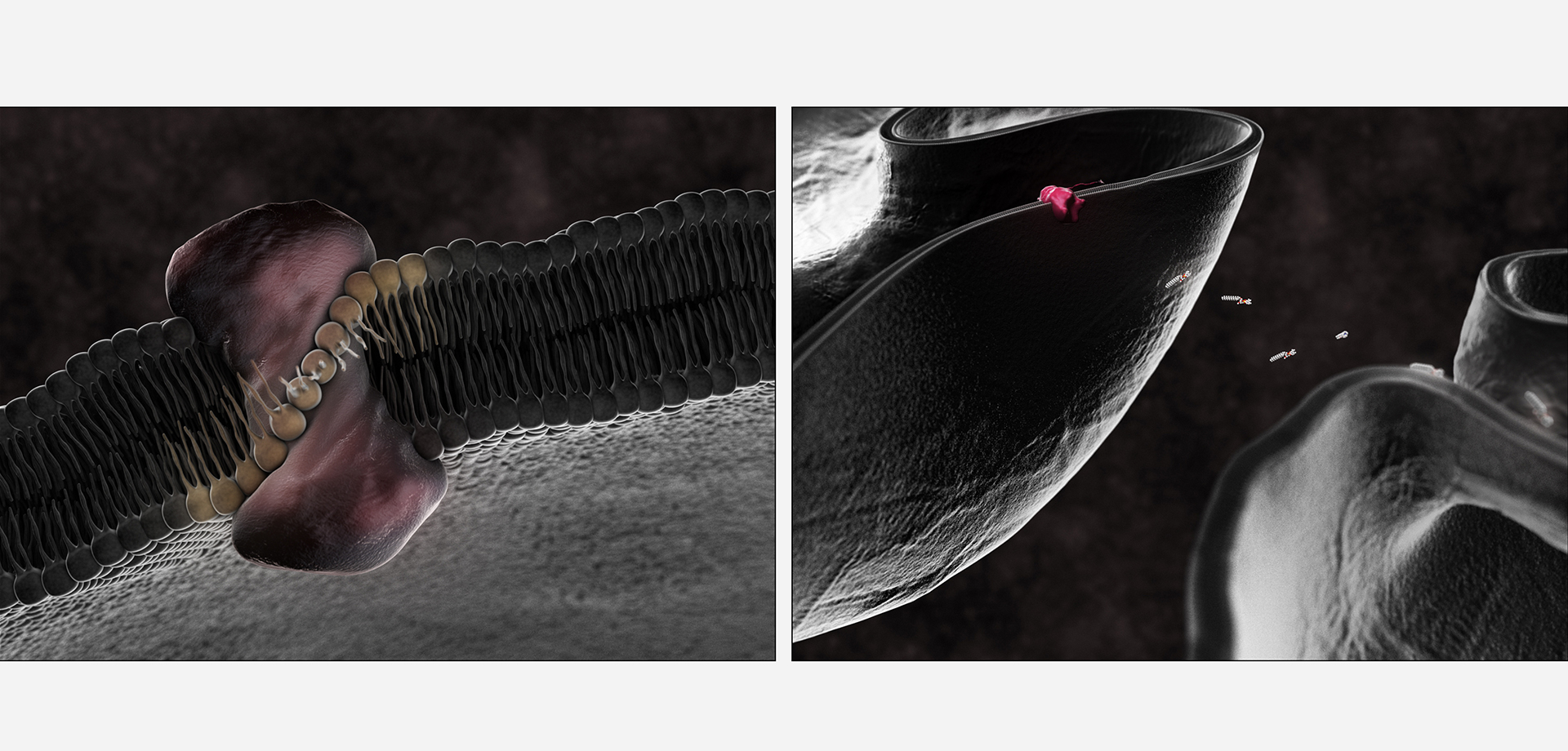
When Nico worked at CIMS, his desire to continue learning was clear with his involvement in the formation of the CIMS Journal Club – a weekly gathering to discuss selected journal articles related to current fields of interest. Through reading topics such as the connection of the body and anatomy to architecture and computer modelling and graphics, Nico brought his three interests of architecture, anatomy, and graphic design together – something that also was visible in his contributions to the CIHR Training Program in Neurodegenerative Lipidomics. On this project, Nico helped visualize and animate how the minuscule lipids within the body act when exposed to diseases such as Alzheimer’s. According to Nico, contributing to research that advances the understanding of horrible diseases is one of the achievements he is most proud of while working at CIMS.
When asked to look at CIMS today versus the CIMS from when he was a researcher, Nico noted that the main differences were the size, skill, competency, and expertise. As he states, *“all those things have become even stronger than they were. Not that they were ever missing. They are just more refined and stronger now.” *
CIMS has grown exponentially since Nico was a researcher. His impact on the development of the policies and practices of CIMS, and his passion for research, learning, and making the invisible visible, have helped the lab become what it is today.