
Welcome to the CIMS Robot Lab
Digitally Assisted Fabrication (DAF) is one of the five main streams of research at the Carleton Immersive Media Studio. The aim of our research is how the use of digital fabrication technologies can be integrated into heritage workflows to relieve some of the burden – and augment the work of – a traditional craftsperson. This stream of research began in 2013 with the proposal of the use of 3D printing, Computer Numeric Controlled (CNC) routing, and robotic milling for heritage conservation and rehabilitation projects. In the following years, CIMS has partnered with architects, stone masons, and the Dominion Sculptor of Canada on a variety of projects that integrate tradition craft with digital fabrication, and on prototyping manufacturing workflows for CNC milling. Our projects are primarily related to the rehabilitation of the Center Block of the Parliament of Canada, however, the ability to bring the digital into the physical world allows DAF to work alongside many different teams at CIMS on a variety of projects.
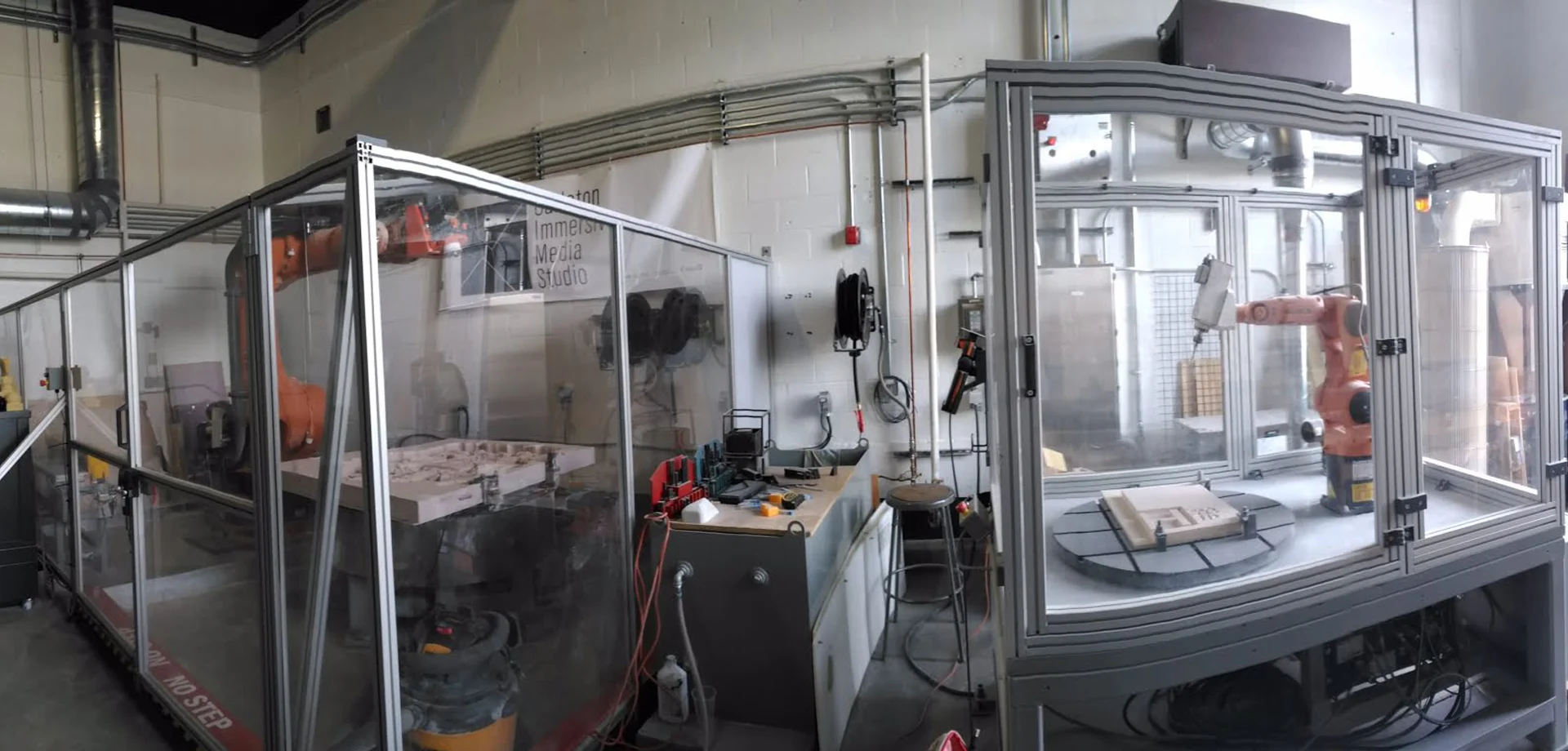
<video src="//videos.ctfassets.net/ujrjk97g2nk9/5VfrkLnLTaw8qKwE8sQ6eI/371b2c17985150dd2bac5053141f8ebd/Welcome_to_the_Robot_Lab.mp4" controls type="video/mov"> </video>The tools for DAF are housed at CIMS and the Azrieli School of Architecture and Urbanism. The 3D printer is located in the CIMS lab while our robotic milling faculties are housed in the school of architecture.
The 3D printer is a form of additive manufacturing: material is layered and joined together to achieve the digital form in reality. One of the tests done for the West Block Rehabilitation Sculptural Elements used 3D printing to demonstrate the accuracy and potential of digital fabrication techniques. A column capitol was printed to replicate the existing weathering conditions that had been captured in the digitization.
In 2016 CIMS acquired two robotic arms. The arms are made by KUKA and have been integrated for the CNC milling of stone, wood, and foam. CNC milling is an example of subtractive manufacturing. In this method of fabrication the material is subtracted from a starting block of material – the stock- to achieve the digital form in reality. The majority of production done at CIMS is done through robotic milling. The two robotic arms are the KR6 and the KR360. Both robotic arms have six axes with an external seventh axis which allows the table the stock sits on to rotate 360°. The smaller robot, the KR6, can lift up to 6kg at a time. It weighs 100lbs and is roughly the size of a human leg. Its smaller size makes it ideal for milling smaller tests (up to 2’ x 2’) in materials that do not require flood coolant (wood, foam) as there is no pump system in place in its enclosure.
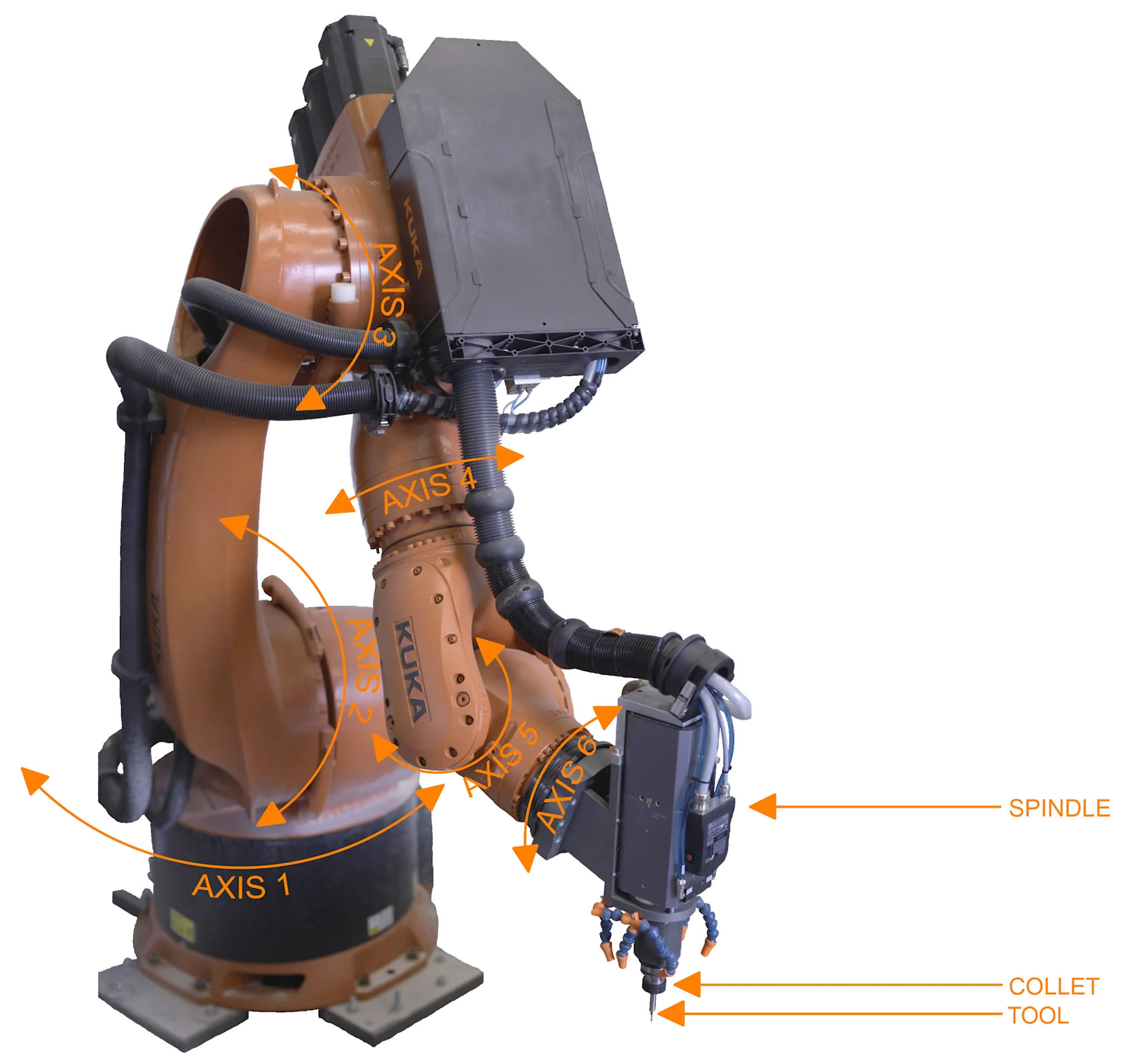
The larger robot, the KR360, can lift 360kg at a time. The KR360 and its enclosure take up a third of the robot lab, and weighs 5 tonnes. The KR360’s enclosure also features flashing, a pump system and a custom rain jacket to enable it to cut stone – which requires flood coolant. Flood coolant refers to coolant that floods the entire stock while cutting (as opposed to coating the surface or tool). In traditional manufacturing the coolant is primarily responsible for clearing away chips to prevent over heating of the stock material and the tool. Flood coolant is especially important when milling stone with a high silica content, like the sandstone that is used on the Parliament Buildings of Canada. When silica dust becomes airborne it can cause lung disease and cancer. By soaking the stock material the dust produced from milling stone is unable to become airborne and can be filtered out through the pump system.
To be integrated for CNC milling both robotic arms are fitted with a high-speed spindle on the end of each arm. The spindle is the motor that rotates the tool at the correct speed for milling. It also features a connection for a tool holder. To attach a tool a collet is inserted into the tool holder and then the tool is inserted into the collet. As the collet is tightened it holds the tool in place with even pressure. With the variety of materials and projects CIMS works on comes a variety of tools. While the same tools for milling wood can be used to mill foam, stone requires much more durable and abrasive tools. Most of the tools for milling stone have electroplated diamonds on the cutting surfaces ensuring that the tool is harder than the surface being cut. With all types of tools, the sharpness of the blade is paramount to achieving a clean and precise finish.
In the past years CIMS has worked on several projects, both research orientated and production orientated. Some of them include: West Block Rehabilitation Sculptural Elements, East Block Owl Carving Rehabilitation, and the GCC Senate Chambers.